

The views expressed in this paper are those of the writer(s) and are not necessarily those of the ARJ Editor or Answers in Genesis.
Abstract
In 2014, Dr Irving Finkel published a translation of the Atra-Hasis text extant on the “Simmonds Ark Tablet” in his book, The Ark Before Noah. He proposed that the original Mesopotamian flood vessel was a giant coracle (a round river boat) rather than a cube as in the Epic of Gilgamesh or the rectilinear vessel described in Genesis 6:14–17. Finkel’s hypothesis relies heavily on his interpretation of the Akkadian word kippatum (“circle”) as defining the final shape of the hull. However, a forensic analysis of the tablet’s internal mathematical data—and the technical appendix in his own book—reveals irreconcilable contradictions to the “Round Ark” hypothesis. This paper demonstrates that: (1) The structural beam dimensions (“ribs”) provided in the text are mathematically insufficient to satisfy a circular plan under any physical configuration. A flat circular layout fails the text’s explicit area requirement (yielding ≈78 sq nindan rather than the required 100), while a curved coracle profile fails the geometric span requirement, as a 10–nindan rib is physically incapable of bridging a 10–nindan width if subjected to curvature; (2) The volume calculations for construction materials reveal a stark contrast between sexagesimal parsimony and irrational complexity: the data yields perfect integers for both rope (4 šār) and bitumen (8 šār) when applied to a square hull, whereas Finkel’s circular model produces chaotic, irrational figures; (3) Finkel’s reconstruction relies on the anachronistic use of modern π rather than the historical Babylonian value of 3⅜, thus distorting the scribe’s original (assumed) geometry; and (4) The internal dimensions utilize the sexagesimal integer “10 nindan” (60 m), creating a 1:1 ratio between the vessel’s length, breadth, and rib span. I conclude that the term kippatum refers to the geometric construction method (circumscribing or inscribing a square) rather than the vessel’s final shape.
Furthermore, a cladistic analysis of the vessels’ geometry reveals a precise mathematical phylogeny descending from Noah’s Ark. The Rectilinear-AH ark serves as the mathematical “missing link”—preserving an historical 10:1 length-to-height ratio of Genesis while slightly rounding down its footprint to achieve a standard 1 field area. The volume too was also converted to a “sexagesimally holy” figure, which the Gilgamesh epic later inflated tenfold. Finkel’s circular interpretation (Finkel-AH) completely severs this hereditary textual chain proving his interpretation is not only structurally unviable, but phylogenetically untenable.
Keywords:Noah’s Ark, Atra-Hasis, Simmonds Ark Tablet, Irving Finkel, Rectilinear-AH model, Finkel-AH model, Genesis Flood, biblical proportions, Mesopotamian metrology, sexagesimal system, ammatu, nindan, ikû, sūtu, parsiktu, soss, nēr, šār
Introduction
The discovery and translation of the “Simmonds Ark Tablet” (dated to the Old Babylonian period, 1900–1700 BC) (fig. 1) by Dr. Irving Finkel (2014) continues to generate significant public interest,1 largely due to Finkel’s novel claim that the “original” Noah’s Ark was a giant circular coracle. Finkel argues that the Hebrew Genesis account is a later derivative that distorted this original circular shape into a rectilinear plan. This aligns with the “Documentary Hypothesis” bias prevalent in secular Assyriology, which assumes Genesis is a derivative of Mesopotamian myth, specifically, the later Epic of Gilgamesh (dated to the Neo-Assyrian Period, roughly 650 BC).
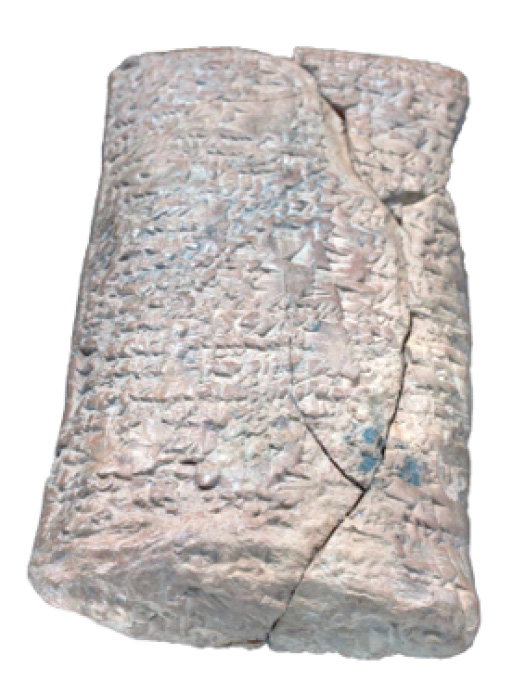
Fig. 1. Cast of “Simmonds Ark Tablet” c. 263, British Museum.
While creationist scholars have previously addressed the theological and chronological assumptions of Finkel’s work (Chaffey 2014), and Statham (2006) made a strong initial case for a square-based design by demonstrating that the material logs and structural rib lengths fit a square floor plan rather than a circle, previous geometric critiques have primarily treated the proposed circular model as a flat cylinder. This paper builds directly upon Statham’s (2006) foundational insights by expanding the engineering critique into three dimensions. To avoid analytical confusion, this study explicitly differentiates between Finkel’s proposed Finkel-AH configuration (Finkel-AH model) and the textually and mathematically consistent square pontoon configuration (Rectilinear-AH model). By evaluating both configurations against the three-dimensional curvature of a traditional coracle profile, this study demonstrates a geometric “double-bind” where both a flat circular raft and a curved hull profile physically fail the text’s explicit structural constraints. By evaluating the vessel through the tablet’s native metrology and converting the translation back into the original Babylonian units (nindan, ikû, sūtu, soss, see table 1), a distinct geometric picture emerges—one that directly refutes the circular interpretation. Furthermore, fresh and startling connections are revealed between the geometry and materials of Noah’s Ark, and the Atra-Hasis and Gilgamesh arks in terms of a phylogenetic sequence—likely driven by Mesopotamian sexagesimal idealism and cosmic religious influences. Placing the Finkel-AH in the middle of this sequence breaks the evidence of a clear chain of inheritance from Noah’s Ark to the vessels of the later Mesopotamian traditions, thus robbing Noah’s Ark of an indirect historical witness.
| Unit | Measurement Type | Mesopotamian Definition | Modern Equivalent (Approx.) | Simmonds Ark Tablet Line No. |
|---|---|---|---|---|
| Ammatu (Cubit) | Length | 30 fingers (šu-si) | 0.5 meters | Implicit (Base unit of nindan) |
| Nindan | Length | 12 cubits | 6.0 meters | 9, 14, 16 |
| Ikû | Area | 100 square nindan (10×10) | 3,600 sq. meters (≈0.89 acres) | 9 |
| Sūtu | Capacity / Volume | 10 qû (litres) | 10 litres | 12, 21, 22 |
| Parsiktu | Capacity / Volume | 6 sūtu | 60 litres | 14, 16 |
| Soss | Unitless (Sexagesimal Multiplier) | 601 | 60 | Implicit (Mathematical Tool) |
| Nēr | Unitless (Sexagesimal Multiplier) | 60×10 | 600 | Implicit (Mathematical Tool) |
| Šár | Unitless (Sexagesimal Multiplier) | 602 | 3,600 | 12, 15, 21, 22 |
Table 1. Key Mesopotamian units and their modern equivalents.
Note: Modern equivalents are standard approximations used in Assyriology for the Old Babylonian period, establishing a working scale rather than absolute modern precision.
Mesopotamian metrology and conventions
To accurately evaluate the Finkel-AH hypothesis against the tablet’s internal data, it is first necessary to establish the metrological framework utilized by the Old Babylonian scribes. Table 1 outlines the primary units of length, area, capacity, and the unitless sexagesimal multipliers that govern the mathematical and structural requirements of the vessel compared to modern units.
With these metrological parameters established, the structural and material data provided in the Simmonds Ark Tablet can be evaluated mathematically. The tablet lists highly specific quantities for both the structural framework and the waterproofing materials (bitumen). By applying the unitless sexagesimal multipliers (soss, nēr, and šār) defined in table 1 to the raw material volumes, a stark contrast emerges. As the following material calculations will show, the scribal data yields perfectly rational integer values when applied to a square footprint, while forcing these same figures onto a circular hull result in non-terminating decimal values and chaotic decimal remainders.
To establish a cohesive analytical framework, this study evaluates these four independent core boundaries across the subsequent sections. “The Philological Contradiction: Kippatum vs. Muraku” and “The Mathematical Impossibility of Finkel-AH” confront the structural beam dimensions and rib configurations to test the geometric impossibility of a circular plan under physical constraints. “A Forensic Audit of Finkel’s Technical Report” provides a forensic audit of the material volumes, contrasting the absolute sexagesimal parsimony of a square hull against the irrational complexity of a circular model. Within this forensic analysis, “Anachronistic Use of π” specifically addresses the anachronistic introduction of modern π values against historical Babylonian parameters. Finally, “The ‘Double Witness’: Convergence with Gilgmesh” demonstrates how the native 10-nindan internal dimensions create a perfect 1:1 structural concordance that converges seamlessly with the traditional Gilgamesh architecture, establishing an explicit mathematical and textual lineage.
Finkel’s translation
The text of Simmonds Ark Tablet is provided by Finkel in his book (Appendix 4), the relevant excerpt is given below from the tablet’s obverse face (numbers added for reference, inserted text in [square brackets] assumed by Finkel):
- Wall, wall! Reed wall, reed wall!
- Atra-hasīs, pay heed to my advice,
- That you may live for ever!
- Destroy your house, build a boat; Spurn property
- and save life!
- Draw out the boat that you will make
- On a circular plan;
- Let her length and breadth be equal,
- Let her floor area be one field, let her sides be one nindan (high).
- You saw kannu ropes and ašlu ropes/rushes for [a coracle before!]
- Let someone (else) twist the fronds and palm-fibre for you!
- It will surely consume 14,430 (sūtu)!”
- “I set in place thirty ribs
- Which were one parsiktu-vessel thick, ten nindan long;
- I set up 3,600 stanchions within her
- Which were half (a parsiktu-vessel) thick, half a nindan high;
- I constructed her cabins above and below.”
- “I apportioned one finger of bitumen for her outsides;
- I apportioned one finger of bitumen for her interior;
- I had (already) poured out one finger of bitumen onto her cabins;
- I caused the kilns to be loaded with 28,800 (sūtu) of kupru-bitumen
- And I poured 3,600 (sūtu) of iṭṭû-bitumen within . . .
The Philological Contradiction: Kippatum vs. Muraku
Finkel’s primary argument for a round ark is dependent on line 6–7: “e-ṣir uṣurtu ša elippi . . . kippatum” (“Draw out the boat that you will make on a circular plan”) (Finkel 2014, 86). However, the immediate subsequent command in line 8 creates a geometric oxymoron: “lu-u mit-har mu-ra-ak-ša ù ru-pu-us-su” (“Let her length and breadth be equal”).
In Babylonian geometry, the terms muraku (length) and rupšu (breadth) are exclusively diagnostic of quadrilaterals. A geometric circle possesses a diameter (tallu or pirkum) and a circumference (kippatum), but never distinct “length and breadth”.
So, the immediate conclusion one can draw is that the Atra-Hasis ‘ark’ is a 10 ×10 × 1 nindan square-based pontoon-like construction.
The surveying context (Si. 427)
The interpretation of Simmonds Ark Tablet must be grounded in the mathematical practices of the period. I previously noted (Cox 2021) that the analysis of tablet Si. 427 (dated 1900–1600 BC) demonstrates that Old Babylonian surveyors possessed a highly sophisticated understanding of geometry (fig. 2), utilizing Pythagorean triples to construct accurate perpendicular field boundaries.
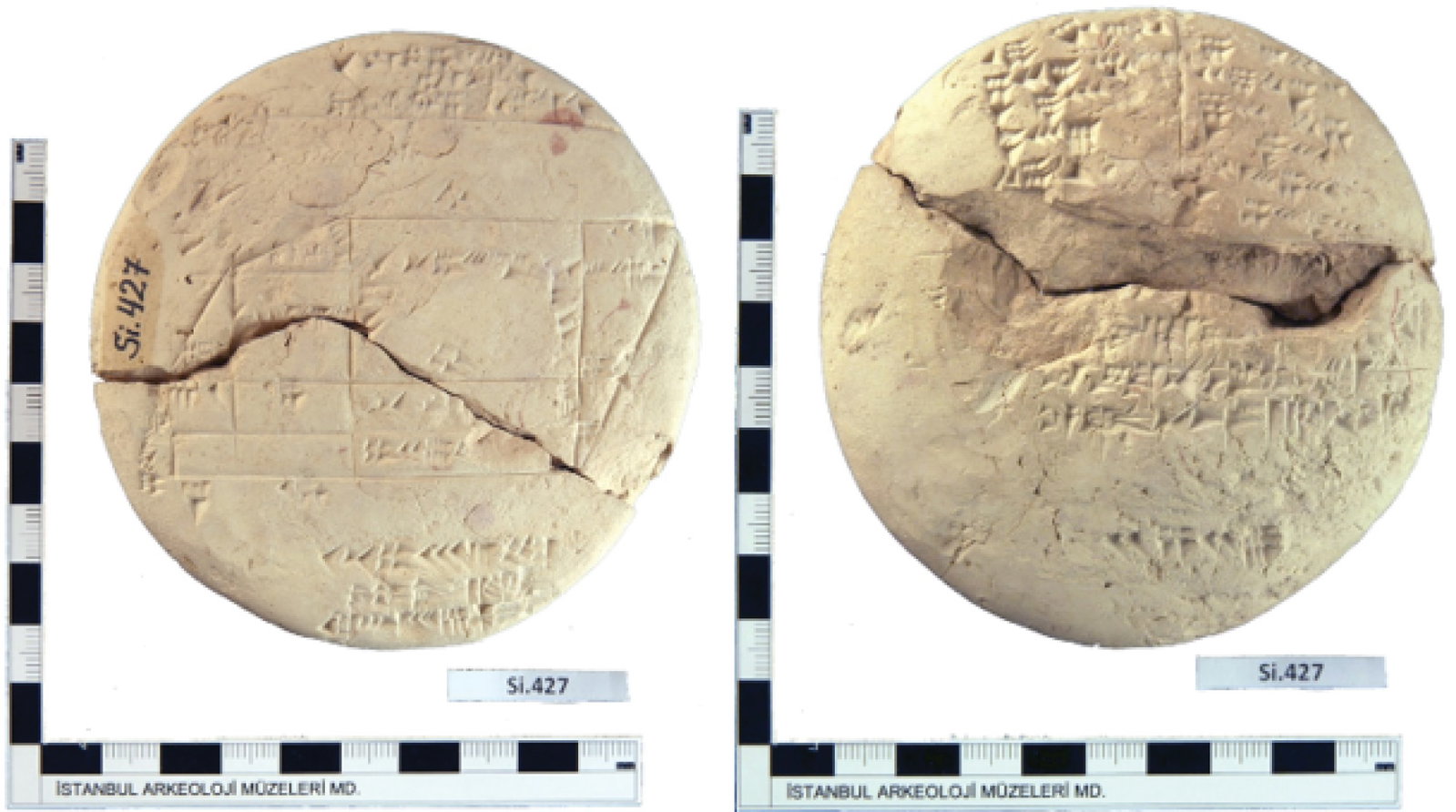
Fig. 2. Si.427 Old-Babylonian Akkadian cadastral text, eighteenth century BC, Sippar.
I state that the tablet “demonstrates the Babylonian surveyors were highly skilled at producing mathematically accurate boundaries”. This obsession with perpendicular precision supports the reading of muraku and rupšu as defining a right-angled structure.
Therefore, the reference to a kippatum in the Ark Tablet refers not to the ark’s shape, but to the method of construction—specifically the drafting of the plan. Ancient surveying techniques for establishing perfect squares involved the “peg and cord” (or compass) method: drawing a circle (kippatum) to establish equidistant corners for a square, where the circle is inscribed within the quadrilateral boundary, is well known (see below).
The pedagogical evidence (BM 15285 and YBC 7289)
These specific drafting practices are well-attested in scribal education; indeed, an Old Babylonian tablet (BM 15285) (fig. 3) held in the British Museum, features student exercises explicitly showing circles inscribed and circumscribed with squares (Finkel 2014), confirming that “squaring the circle”-or using a kippatum to define a quadrilateral boundary-was a fundamental geometric technique practised by the scribes of the period. This confirms that scribes were trained to understand the geometric relationship of inscribed circular fields within a square boundary.
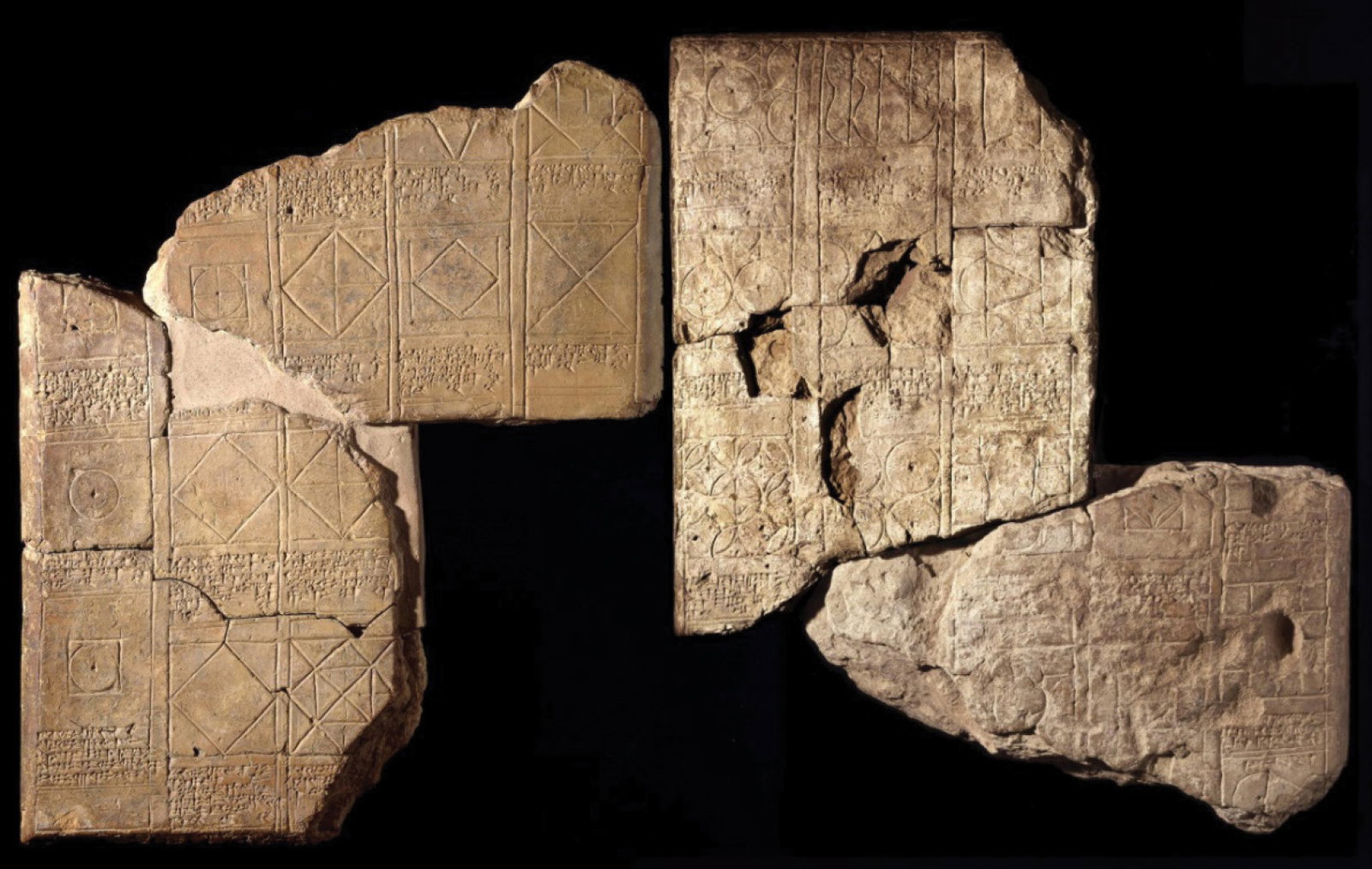
Fig. 3. BM 15285, Old-Babylonian geometry teaching exercise, demonstrating an inscribed circle within a quadrilateral framework.
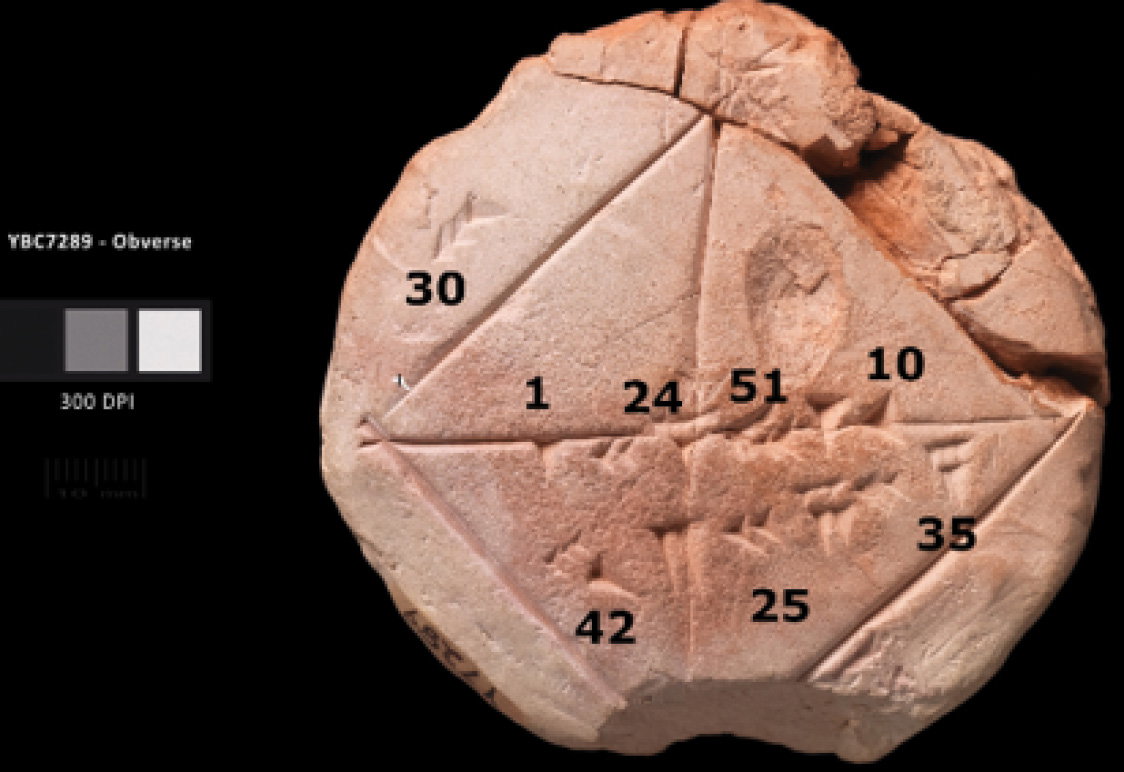
Fig. 4. YBC 7289 circular tablet, obverse, sexagesimal, Pythagorean square root of 2 for isosceles triangle.
Additionally, another tablet YBC 7289 (fig. 4) (approx. 1800–1600 BC) depicts a square with diagonals drawn onto a circular clay tablet. This reinforces the scribal habit of using a circular medium to define square geometry.
When the Ark Tablet commands the builder to “Draw out on a kippatum” and immediately follows with “Let length and breadth be equal,” the scribe is invoking this standard classroom geometry: using a circle with a central radius to define a square floor plan. Finkel’s interpretation ignores this pedagogical context, conflating the geometric scaffold (the circle) for the floor plan of the boat.
Finkel’s fallacy: The construction circle vs. the hull
The fundamental error in Finkel’s interpretation—building upon the critique established by Statham (2006), a misstep I term “Finkel’s Fallacy”—lies in conflating the geometric construction method with the architectural result.
As evidenced by the pedagogical tablet BM 15285 (Finkel 2014), Babylonian scribes were trained to construct squares by using an inscribed central circle (kippatum) as a geometric reference. This method ensures that the length and breadth are equidistant from the centre.
- The Circle: The ‘survey method’ (radius 30 m) used to establish the perimeter.
- The Square: The supposed vessel’s floor plan (width 60 m).
By interpreting the kippatum as the hull itself, he forces the text into irreconcilable mathematical contradictions that the original scribe never intended (see The Mathematical Impossibility of Finkel-AH onwards).
Comparative evidence: The Map of the World (BM 92687)
A comparison with the “Imago Mundi” Babylonian Map of the World (BM 92687) (fig. 5) provides a linguistic control. This tablet, also translated by Finkel, depicts the cosmos as a true geometric circle (a disk surrounded by the “Bitter River”). Notably, the text describing this circular cosmology does not utilize the quadrilateral terms muraku (length) and rupšu (breadth) to define the primary shape.
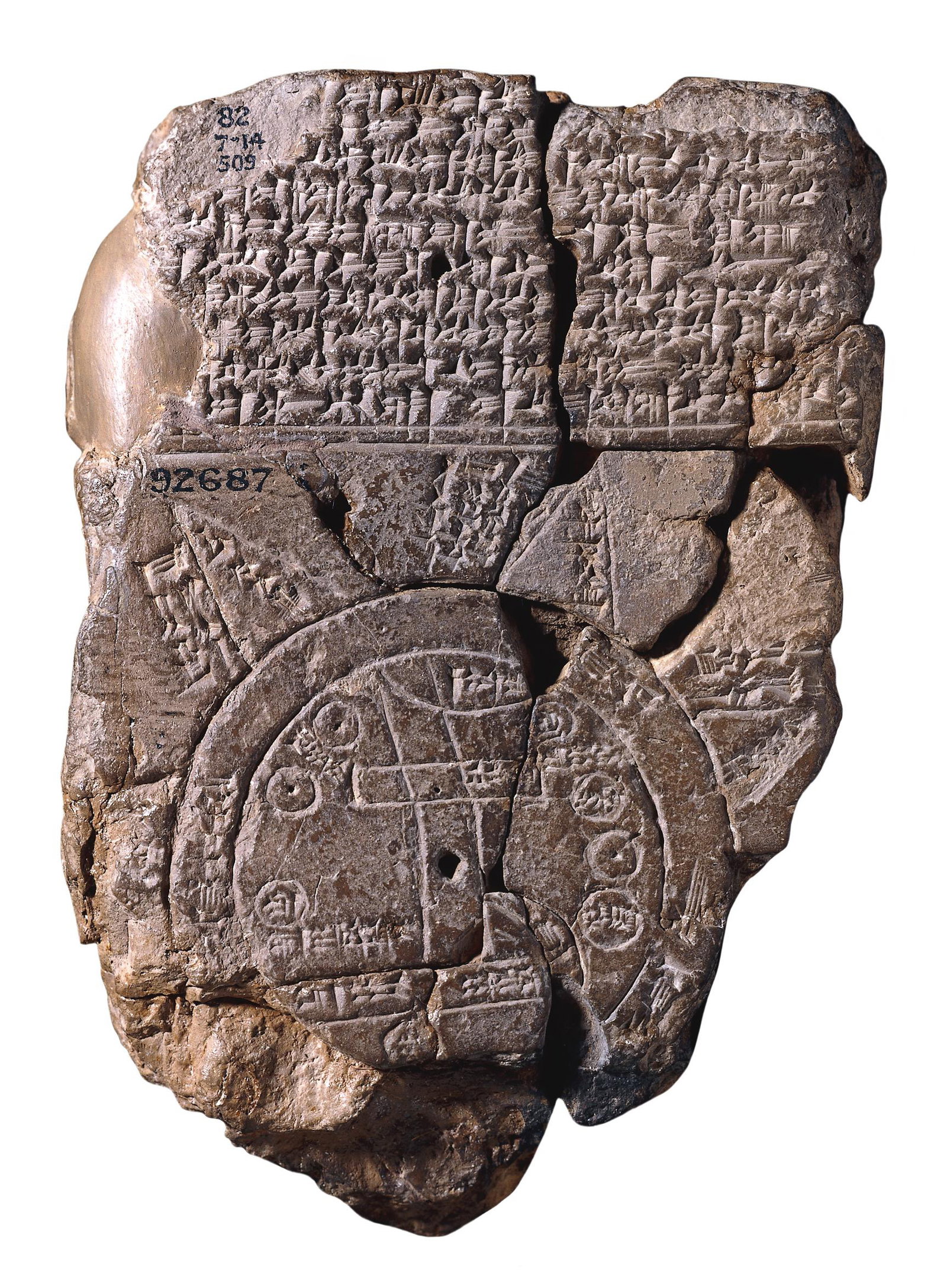
Fig. 5. “Imago Mundi” Babylonian Map of the World (BM 92687).
Furthermore, a distinct linguistic link exists between these texts. Simmonds Ark Tablet (line 14) utilizes the rare term parsiktu to describe the thickness of the ark ribs (“thick as a parsiktu vessel (ten fingers thick).” This exacting constellation of Akkadian words, according to Finkel, reappears only in cuneiform literature within the Imago Mundi (reverse face) in the context of the remains of the Ark, described as being located in the Urartu mountains (modern-day Ararat) on the obverse face.2 This philological “double-witness” confirms that Simmonds Ark Tablet belongs to the same scribal tradition as the Imago Mundi—a tradition that explicitly places the Ark in the mountains of Ararat, aligning with the biblical geography.
The Mathematical Impossibility of Finkel-AH
While the philological and historical evidence strongly contradict a localized marshland coracle, the most definitive refutation of Finkel’s hypothesis lies in the realm of pure geometry. To determine if the “Round Ark” could exist as a physical reality, it must survive a rigorous structural audit using the Babylonian scribe’s own engineering specifications. The tablet provides three governing variables that must mathematically align:
- Floor Area: 1 ikû (one field).
- Rib Length: 1 ikû (one field).
- Shape: “Length and breadth are equal.”
Unit standardization
To test the internal consistency, the scribal units must be used:
- 1 nindan (approximately 6 m).
- 1 ikû = 100 square nindan.
Test A: The area-derived deficit (full circle)
Building upon the foundational analysis of Statham (2006), I test the internal consistency of Finkel’s circular interpretation against the tablet’s explicit area requirement. If the mandated floor area of 100 sq nindan (1 iku) is applied to a true geometric circle, the radius required to satisfy this area is isolated by setting Area (A) equal to 100:
This yields a required circular hull diameter (vessel width, W) of exactly 11.2838 nindan (2 × r, approximately 67.7 m). This calculation reveals the immediate flat-profile structural failure first identified by Statham (2006): the cuneiform text explicitly dictates that the structural ribs are exactly 10 nindan long. If the vessel is configured as an area-compliant circle, a straight radial floor beam requires a span of 11.28 nindan to cross the center. The text’s 10-nindan ribs are fundamentally 1.28 nindan (7.7 m) too short to bridge the hull, leaving a massive structural gap in a flat layout. Finkel’s reconstruction relies on a vessel that cannot be structurally supported by the materials listed in the text (fig. 6).
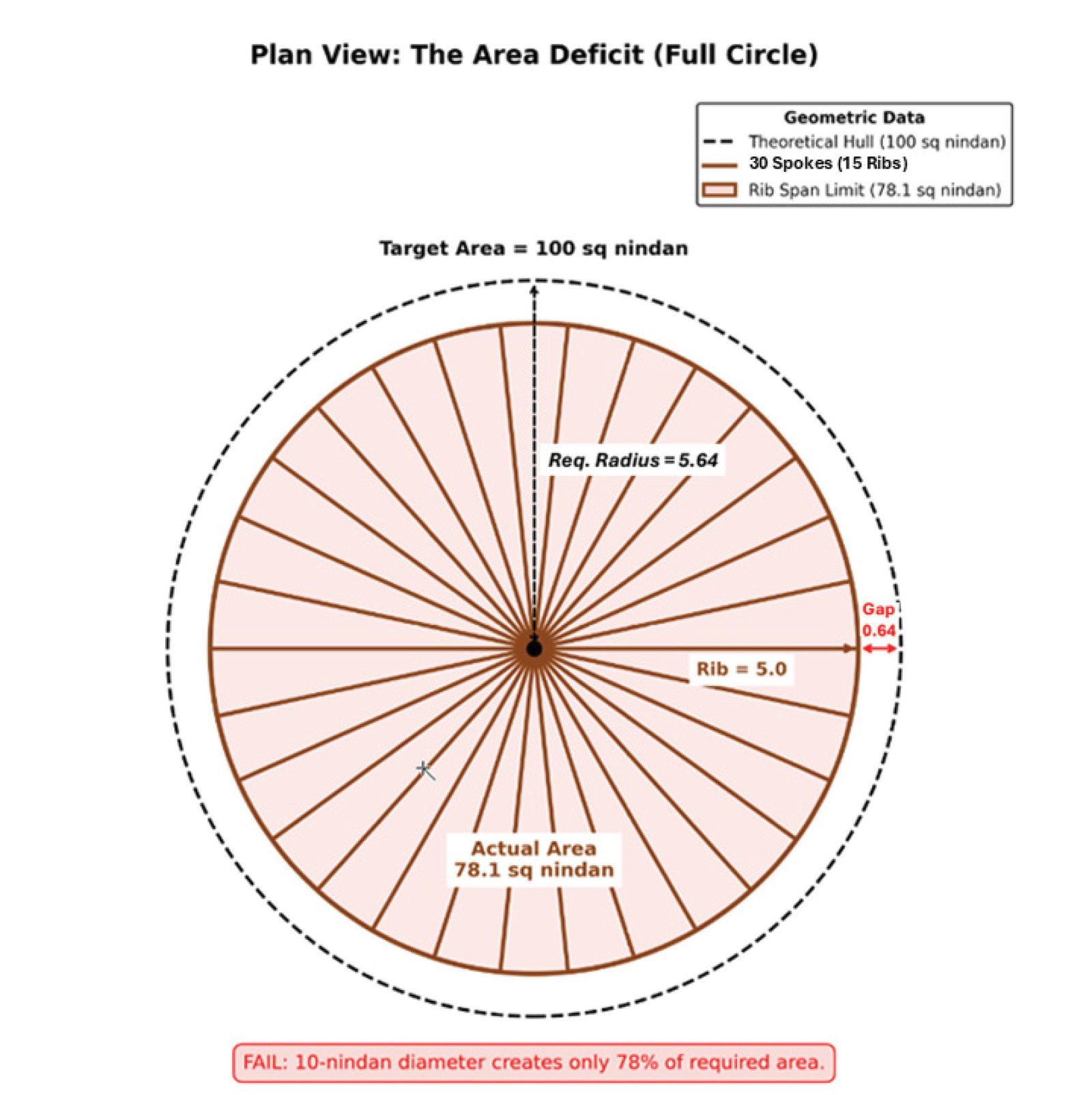
Fig. 6. Simple schematic of Finkel’s round coracle showing horizontally flat radial ribs of 10 nindan length spanning an area-compliant hull diameter of 11.28 nindan, demonstrating that a 5.0 nindan radial rib layout leaves an unbridgeable 0.64 nindan (3.8 m) perimeter gap, forcing a complete structural disconnection between the internal framework and the hull.
Alternatively, if we make the coracle diameter to be exactly , how does this affect its area in relation to what is stated in the text (see The “one ikû contradiction” below)?
The “one ikû” contradiction
Beyond the structural impossibility of the rib lengths, Finkel-AH hypothesis fails to satisfy the explicit area specified in the text. The Ark Tablet (line 9) and Gilgamesh tablet XI (line 58) (Finkel 2014) states: “One ikû was its area,” (alternatively, one “acre,” or “field”).
In Old Babylonian metrology, one ikû is strictly defined as 100 musar (square nindan). This creates a precise mathematical test for any proposed reconstruction: does the geometry yield an area of 100 sq. nindan based on the stated width of 100 nindan if the ark is a round coracle?
The circular area-width mismatch
Alternatively, if an analyst attempts to force the 10-nindan structural rib length to function as the maximum diameter of a flat circular hull profile, the resulting floor area collapses. Utilizing the standard Old Babylonian constant for Pi (3.125), a circle restricted to a 10-nindan diameter yields an area deficit. While Statham (2006) first demonstrated this structural floor area collapse using modern geometric values, evaluating the calculation strictly through the ancient Babylonian constant (3) confirms the exact mathematical parameters confronting the contemporary scribe:
This calculation demonstrates that a circular interpretation bound strictly to a 10-nindan linear dimension generates only 78.1% of the floor area explicitly demanded by the scribe (“one ikû” or 100 square nindan). As Statham (2006) observed, a Babylonian scribe—member of a professional class deeply preoccupied with metrological precision—would not conflate a calculation of 78.125 sq. nindan with a standard 100-nindan field footprint.
The square concordance
Conversely, if the dimensions describe a square floor plan (the cubic model), the calculation is exact:
Conclusion on area deficit
The Simmonds Ark Tablet text can only display internal mathematical consistency when: a width of 10 and an area of 100 implies a square (10 × 10 = 100). A circular interpretation forces a mathematical error onto the scribe, assuming they conflated 78 with 100—a magnitude of error unthinkable for a culture obsessed with metrological precision.
Testing the square hypothesis
If the area (100 sq nindan) applies to a square of sides (s): A = s2:
The structural fit
- Side Length: 10 nindan.
- Rib Length: 10 nindan.
The ratio is a perfect 1:1 integer match. The beams described in the text fit the width of the vessel exactly. This favours the Babylonian preference for “clean” sexagesimal integers over the non-terminating decimal values necessitated by Finkel’s circular theory.
A simple matrix of 15 vertical and 15 horizontal ribs of 10 nindan length shows the implied structural integrity (fig. 7) of the Simmonds Ark Tablet text as translated by Finkel.
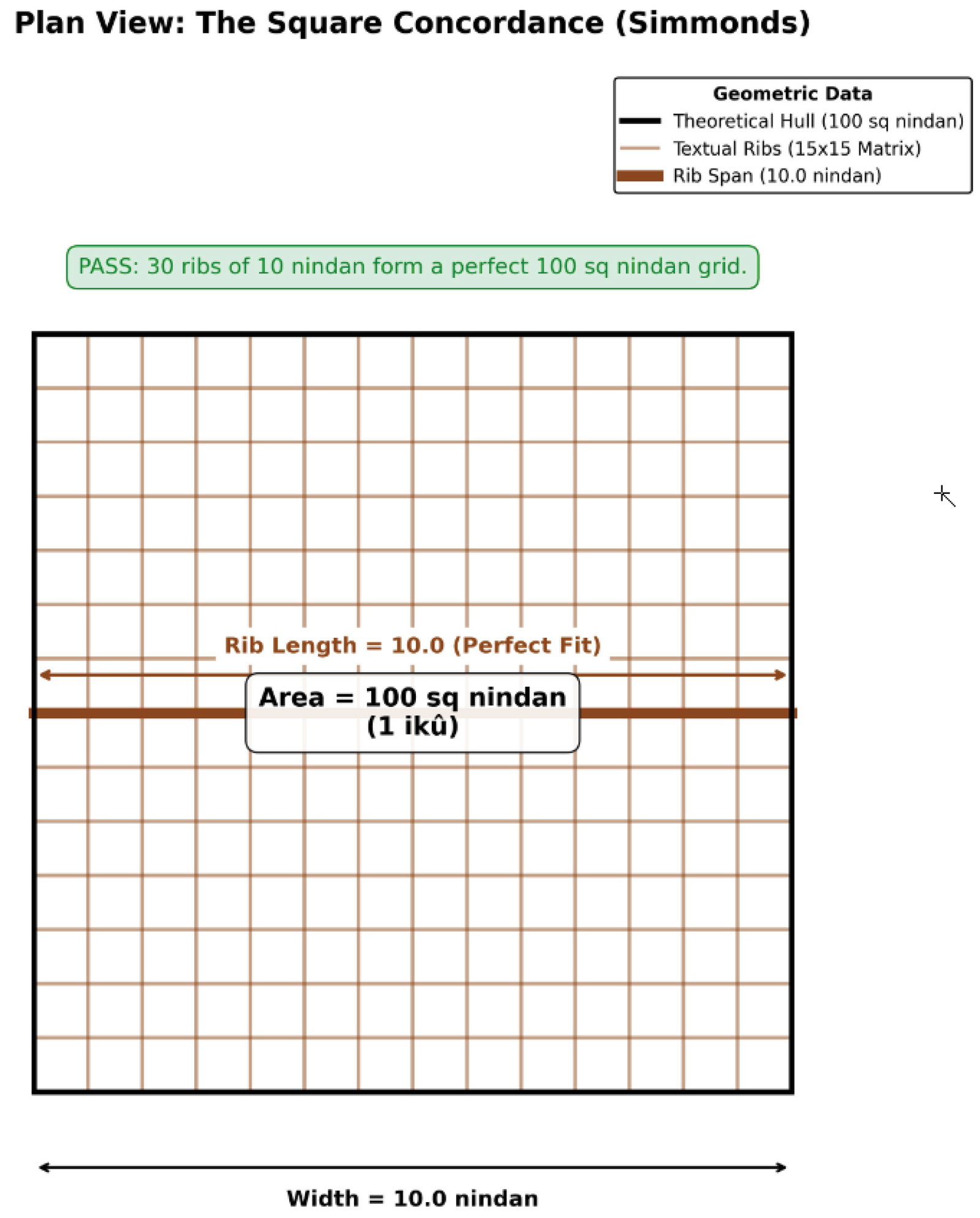
Fig. 7. Matrix of 30 ten–nindan ribs placed within the 100 sq nindan area described in the Simmonds Ark Tablet reveals the elegant simplicity and structural integrity of a bidirectional 15 × 15 crosshatch matrix. While the text specifies 30 ribs total without explicitly prescribing their orientation, a balanced distribution of 15 longitudinal and 15 transverse timbers represents the standard structural configuration to evenly support a square 10-nindan floor plan.
Test B: The width-derived deficit (the Simmonds profile)
A critical flaw in Finkel’s “Round Ark” hypothesis emerges when the structural members are tested against the specific dimensions of the Simmonds Ark Tablet. This tablet specifies a vessel with length and breadth of 120 cubits (1 nindan) and a wall height of 12 cubits (1 nindan). The defining ratio is L = W = 10H.
While the linear dimensions (10 × 10 × 1) describe a functional barge or raft, the coracle interpretation requires us to view these dimensions as the geometry of a curved hull. Compounding the fact that the textual ribs are already 22% too short to achieve the required floor area, forcing a curved coracle profile introduces a second, equally fatal geometric contradiction: the “Shortest Path Problem”.
The arc-chord discrepancy
The text specifies that the ribs are “10 nindan” long. We must test if a 10–nindan timber can construct a vessel of 10–nindan width under both models.
Scenario A: The linear model (Simmonds)
If the vessel is a square barge, the floor is flat. The structural rib lies horizontally to form the floor beam.
- Geometry: A straight line is the shortest distance between two points.
- Calculation: To span a width of 10 nindan, a beam of 10 nindan is required.
- Result: Perfect Concordance. The material list matches the dimensional requirement exactly (1:1 ratio).
Scenario B: The radial model (coracle)
In a traditional Finkel-AH design, the rib must curve to form the hull profile. Even if we assume the shallow profile specified by the Simmonds Tablet (height = 1 nindan) the rib must travel a path longer than the linear width to accommodate the curvature.
Consequently, the total structural length required for a curved rib must exceed the 11.28 nindan flat-diameter baseline, compounding the deficit beyond the initial 22% shortfall. To demonstrate that this is a geometric necessity rather than an approximation, I apply the standard theorem for circular segments (the “Intersecting Chords Theorem”) to derive the exact span.
This continuous radial baseline is not presented as an accurate ethnographic coracle profile. Rather, it is established as a strict geometric control to test the literal mathematical boundaries of a continuous-arc “Round Ark” hypothesis.
Step 1: Establishing the curvature (the target radius).
The Simmonds Tablet specifies a vessel with a width (W) of 10 nindan and a wall height (H, or sagitta) of 1 nindan. If we interpret this profile under an idealized, continuous circular arc model (representing the geometric baseline required by Finkel’s dimensions, though distinct from the flat-bottomed geometry of traditional ethnographic coracles), the radius (R) is fixed by these two points:
Substituting the dimensions (W = 10, H = 1):
Step 2: Calculating the required arc length
To bridge this literal 10–nindan textual width with a 1–nindan rise, the rib must follow a radius of curvature of R = 13.0 nindan. (The alternative case expanding the width to an area-compliant 11.28 nindan is evaluated separately below).
The angle (θ) subtended by this arc is:
The required rib length (Lreq) is R × θ:
Step 3: The material deficit (the actual span)
The text, however, explicitly lists the ribs as 10.0 nindan. Since 10.0 < 10.26, the rib is physically too short to bridge the gap even under this literal, unexpanded width baseline. (As shown in the subsequent area-compliant analysis, expanding the width to satisfy the floor plan area causes the required curved rib length to balloon even further to 11.52 nindan.
If the available 10–nindan rib is bent to the required radius (R = 13), the actual maximum span (wactual) is:
Conclusion
The Radial model forces a mathematical contradiction. A 10–nindan rib cannot physically span a 10–width if it has any curvature. As shown in fig. 8, the radial interpretation creates a structural gap of 0.24 nindan in the hull width.
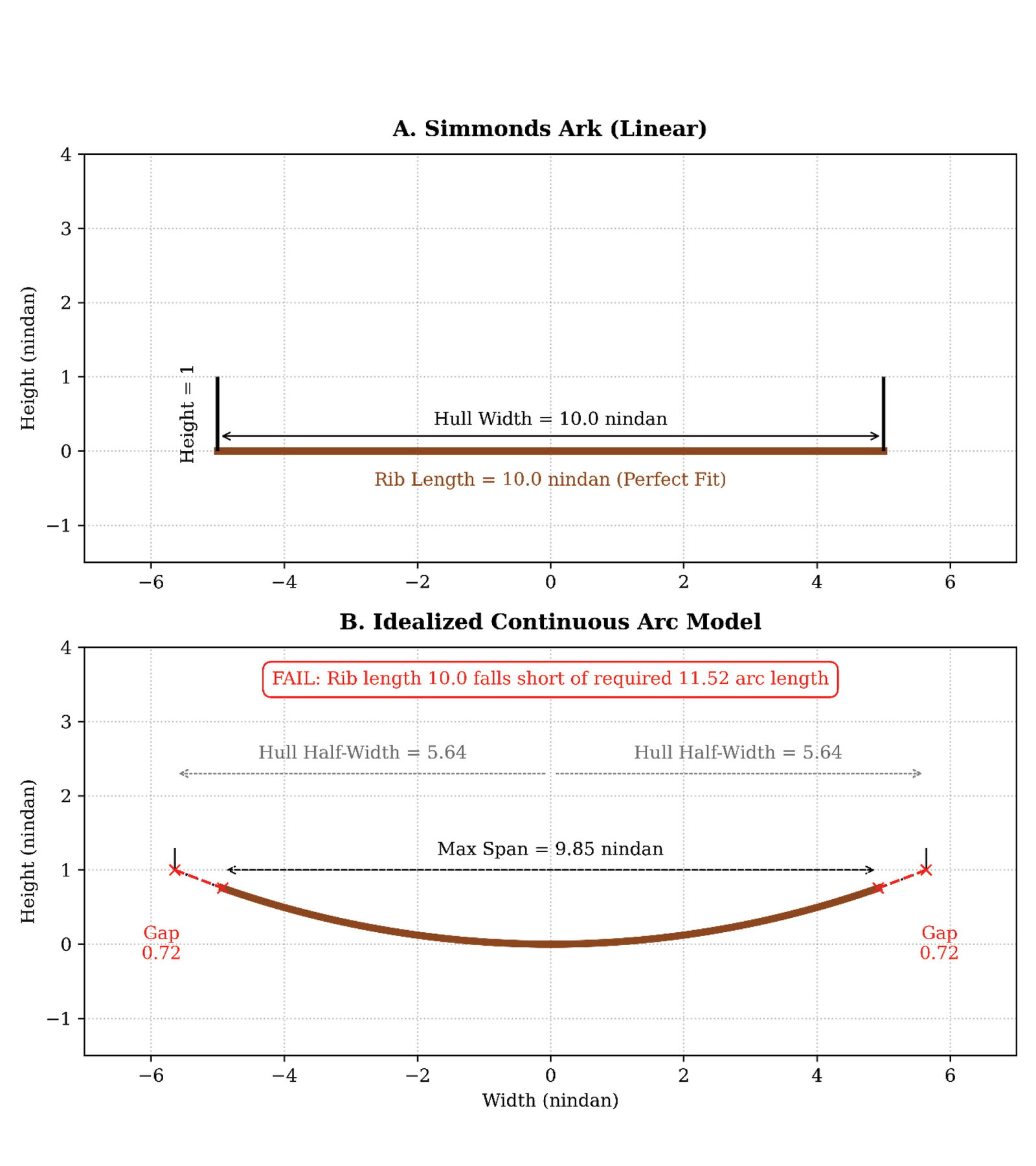
Fig. 8. Structural section analysis: The “shortest path” deficit in radial models.
The square model requires no such error. The “10 nindan” rib is not an approximation; it is the precise geometric solution for a square flat floor. The text describes a square because only a square allows a 10–nindan beam to create a 10–nindan width.
Panel A (top): The linear concordance (Simmonds Tablet)
Cross-section of the vessel described in the Simmonds Tablet (10 × 10 nindan floor plan with 1 nindan walls). The textual requirement for a 10–nindan structural rib perfectly satisfies the geometric requirement for a 10–nindan floor width. The linear span represents the shortest path between the vessel walls, resulting in a 1:1 concordance between material length and vessel width.
Panel B (bottom): The radial failure (Finkel-AH model)
Cross-section of a curved radial profile attempting to span the required 11.28 nindan area-compliant diameter using the text-specified 10.0 nindan ribs. Panel B illustrates the idealized, continuous circular arc profile required to test Finkel’s dimensional parameters. Note that this geometric baseline represents a simplified mathematical model for analysis and departs from traditional ethnographic coracle construction, which typically features a flatter floor profile and distinct bilge turns.
- The constraint: To construct a vessel with a fixed wall height (H) of 1.0 nindan and an area-derived width (W) of 11.28 nindan, the required radius of curvature is fixed at 16.42 nindan.
- The deficit: To physically bridge this curved framework from wall to wall, an arc length of 11.52 nindan is required. Because the text limits the builder to 10.0 nindan timbers, bending the rib to this curvature yields an actual horizontal chord span of only 9.85 nindan.
- The result: The structural framework falls catastrophically short of reaching the hull boundaries by a cumulative 1.43 nindan (8.6 m), leaving an unbridgeable structural chasm.
Lexical precision in Babylonian geometry
It is demonstrably false to suggest that a Babylonian scribe would conflate linear length with arc length. Babylonian mathematics was highly advanced regarding circular geometry. They possessed distinct geometric methods for analyzing the circular plane (kippatum) and routinely derived its perimeter by calculating the precise arithmetic relationship between a circle’s diameter and its boundary.
The text employs the standard orthogonal vocabulary of Uš (Length/Height) and Sag (Width). These are terms of linearity, used for fields, walls, ziggurats, or arks. They are strictly Cartesian. Had the scribe intended to describe a round vessel with a 10-nindan width, he would have either:
- Specified the perimeter of the circle as either exactly 30 nindan (using the standard Babylonian constant of 3) or 31.25 nindan (using the precise constant of 3⅛) to guide the weaving of the hull) or
- Specified a rib length of 11.52 nindan to achieve the required area-compliant diameter.
By insisting on “10 nindan” for the structural members, the scribe explicitly describes a straight-edged object. A “round boat” built with “10–nindan ribs” is a geometric impossibility—a circle that cannot close. Thus, the coracle hypothesis requires the text to be wrong about the very materials it claims to list.
A Forensic Audit of Finkel’s Technical Report
In his technical appendix (no. 3), co-authored with mathematician, Mark Wilson, Finkel attempts to reconcile the material quantities listed in Simmonds Ark Tablet with his circular reconstruction. However, a close examination of Wilson’s calculations reveals that the tablet’s data favours a square hull.
Sexagesimal parsimony: The 8 šār and 4 šār proofs
The tablet lists the precise volume of bitumen (kupru and itû) required to waterproof the hull as 28,800 sūtu. To determine if this number represents a measured reality or a schematic ideal, we must convert it into the primary sexagesimal unit, the šār (where 1 šār = 3,600).
The bitumen calculation:
28,800 sūtu ÷ 3,600 = 8 šār
The total volume is not a random measurement derived from a complex circular geometry; it is exactly 8 šār. This indicates the scribe was working with idealized sexagesimal integers rather than empirical measurements.
The rope calculation
Similarly, the tablet explicitly specifies a rope volume equivalent to 14,430 sūtu. However, as Finkel acknowledges in his own data (2014, 242–243), the theoretical requirement for a square ark would be 14,400 sūtu.
Finkel states the volume of rope used is equivalent to a length of 527 km which he assumes is used to weave the basket for his mega coracle (Finkel 2014, 132). Nevertheless, the use of rope is by no means proof of coracle construction. Palm-fibre rope was standard in ancient Mesopotamian shipbuilding for lashing heavy structural timbers and securing bitumen wadding, regardless of the vessel’s geometric footprint. This is decisively proven by the Epic of Gilgamesh, which describes a rigid, multi-decked, 10-nindan perfect cube, yet explicitly lists “ropes of palm-fibre” among its primary construction materials (George 2003; Tablet XI, line 54). Thus, the mention of rope in Atra-Hasis indicates standard structural lashing, not proof of a circular basket.
Summary of parsimony
The data reveals a clear schematic pattern:
Bitumen: Exactly 8 šār (8 × 3,600).
Rope: Exactly 8 šār (8 × 3,600).
The scribe was not calculating the irrational surface area of a round boat, which would yield messy decimals (for example, Finkel’s circular rope calculation of ~14,648). Instead, the scribe simply assigned “Holy Integers” (8 and 4) to the materials. This proves the vessel was a theoretical rectilinear construct based on sexagesimal perfection, not a physical coracle.
Anachronistic use of π
A critical methodological error in Finkel’s reconstruction is his use of the modern value for π (3.14159. . .) to “back-calculate” the Ark’s dimensions. As noted by Buckle (2025), the standard Old Babylonian approximation for π was 3 (3.125).
By using modern mathematical constants to interpret an ancient text, Finkel introduces anachronistic precision that obscures the sexagesimal (assumed) logic of the original scribe. Had Finkel utilized the Babylonian π (3.125) everyday practical constant (3), the geometric discrepancies in his circular model would be even more pronounced. While the preceding engineering sections of this paper deliberately utilized modern pi to evaluate Finkel’s specific published values on their own mathematical terms, applying the actual ancient sexagesimal constants only worsens the geometric failure. The fact that the “Square Ark” calculations yield perfect integers (4 šār) without the need for any version of π further confirms that the vessel was rectilinear.
Surface area parsimony: The “perfect 120” test
A definitive test of the intended geometry can be performed by analysing the relationship between the total volume of bitumen (kupru and ittû) and the vessel’s total surface area. The tablet specifies a precise volume of 28,800 sūtu of pitch.
Unlike the Epic of Gilgamesh, which describes a perfect cube (120 × 120 × 120 cubits), (George 2003) Simmonds Ark Tablet describes a low-profile vessel: a square floor of area 1 ikû (100 sq nindan) with walls only 1 nindan high (line 9: “lu-u ištēn nindan . . . lilâša”).
We can test which geometric model—the square pontoon or Finkel’s assumed round coracle—yields a rational coating ratio for this specific surface area.
Hypothesis A: The rectilinear barge model
Calculating the total surface area (Atotal) for a square vessel with a roof (as implied by the command “roof her over”):
Floor: 10 × 10 = 100 sq nindan
Roof: 10 × 10 = 100 sq nindan
Walls: 4 side × (10 wide × 1 high) = 40 sq nindan
Total Surface Area: 100 + 100 + 40 = 240 sq nindan
When we divide the pitch volume by this area:
The result: The output is 120—exactly 2 “soss” (2 × 60). This is a mathematically perfect sexagesimal integer, indicating the scribe calculated the bitumen based on a precise application rate of “2 soss per unit.”
Hypothesis B: The Finkel-AH model
If we apply the textual dimensions to a circular vessel (where Floor Area A = 1 iku = 100 sq nindan), we must first derive the geometric properties of that circle to find the wall length (circumference).
Deriving the geometric radius
Deriving the geometric circumference
Calculating total circular surface area
The wall height is:
- Floor: 100 sq nindan
- Roof: 100 sq nindan
- Walls: 35.45 (circumference)×1 (height)=35.45 sq nindan
Total surface area:
Evaluating the structural pitch coefficient
Dividing the total pitch volume by this surface area yields the theoretical coating thickness:
Conclusion on Surface Area
The “Square” hypothesis yields a perfect sexagesimal integer (120), while the “Round” hypothesis yields a non-terminating decimal value (122.318...). It is inconceivable that a Babylonian scribe, working in base-60, would select a pitch volume of 28,800 unless it was derived from the rational geometry of a square. The maths proves the kippatum referred to the drafting method, not the hull shape.
This stark divergence addresses a vital pragmatic imperative of ancient Near Eastern construction management. For a Babylonian scribal administrator, material lists were not abstract mathematical exercises; they dictated real-world labor allocation and material distribution packages measured out in standard whole sūtu and parsiktu vessels. An irrational application coefficient like 122.318 . . . sūtu per square nindan would paralyze the logistical pipeline, preventing tidy allocations to labor gangs. Conversely, the exact integer of 120 sūtu (precisely 2 soss) reflects a deliberate, top-down schematic design where material allocation perfectly mirrors the geometric framework. This proves the scribe calculated the required bitumen based on a precise, idealized application rate of 2 soss per unit area , an administrative reality completely detached from Finkel’s forced circular interpretation.
The “rib gap” and the offset fallacy
Regarding the structural ribs (sēlū), Finkel acknowledges in the appendix that the dimensions are 10 nindan (60 m). Since this length is insufficient to span the calculated 11.3 nindan (67.7 m) diameter of his circular hull, Finkel is forced to postulate a complex, offsetting lattice arrangement where ribs do not cross the centre but run “approximately 8½ nindan along the base” (Finkel 2014, app. 3; see fig. 9).
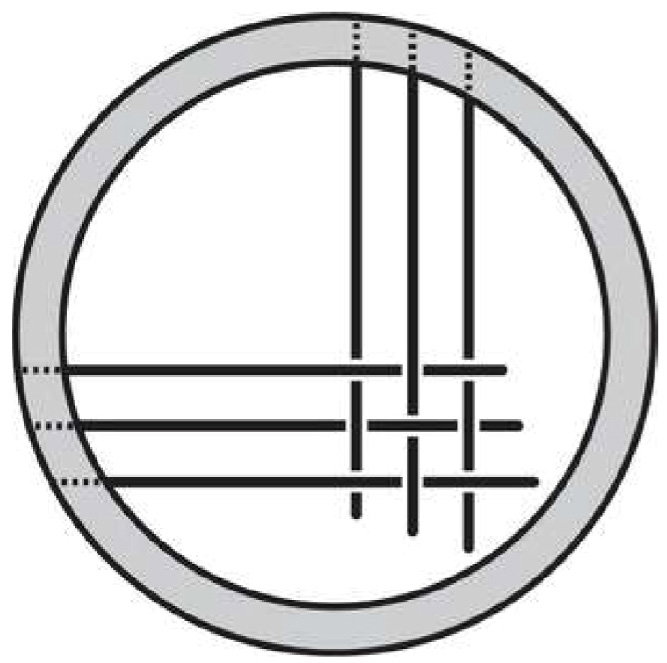
Fig. 9. Finkel’s proposed “solution” for ribs of 10 nindan spanning a circular base of 11.28 nindan (Finkel 2014, app. 3).
This structural complexity is absent from the text and appears to be a post-hoc “paper solution” to a geometric deficit created by his own theory. Notably, in the documentary reconstruction (“Secrets of Noah’s Ark”),3 the boat builders did not utilize this complex “offset/woven” rib method, likely due to the structural unsoundness of creating shear points in the hull framework. They instead utilized traditional radiating ribs and lashing methods, further highlighting the disconnect between Finkel’s theoretical “Round Ark” and the practical realities of naval architecture. Of note also from this documentary is the abandonment of the supporting pillar (stanchion) size, density, and function from Finkel’s theoretical blueprint. Here, just a few, short stanchions were utilized to support a simplified internal platform. The documentary ark is a complete structural departure (not just in size) from the theoretical blueprint presented in Finkel’s book.
The “Double-Witness”: Convergence with Gilgamesh
While the Atra-Hasis tablet describes a low-walled vessel (1 nindan high), the later Gilgamesh tradition expands this vertically into a perfect Cube (10 nindan high). However, both traditions rigidly adhere to the 10 nindan length/width base, confirming a square footprint in both eras.
The strongest evidence that the Atra-Hasis tablet describes a square floor plan comes from a direct comparison with the Epic of Gilgamesh (Tablet XI), which universally describes the Ark as a cube.
- Gilgamesh dimensions: The text states the Ark is 120 cubits (2 soss) in length, breadth, and height.
- The conversion factor: In the Babylonian system, 1 nindan = 12 cubits.
- Calculation:
Conclusion on convergence
Both the Gilgamesh Ark and the Simmonds Atra-Hasis Ark share identical dimensions for their floor plan: 10 nindan × 10 nindan. Finkel’s circular interpretation is a misreading of a square architectural blueprint shared with the Gilgamesh tradition, where the term kippatum denotes the drafting method rather than a circular hull footprint. This confirms the widely held creationist view that the Mesopotamian accounts represent corrupted, mythologized memories of the same event (Landless 2020; Liguori 2022).
Sexagesimal Idealism vs. Reality
Further evidence that the Atra-Hasis tablet describes a geometric abstraction rather than a functional vessel is found in the physical distribution of supports.
A “forest” of stanchions
Line 15–16 states: “I set up 3,600 stanchions within her, that were half (a parsiktu-vessel) thick, half a nindan long (i.e. high).”
This choice of 3,600 (exactly 1 šār) confirms the scribe was prioritizing sexagesimal idealism over architectural reality. By imposing a “Holy Number” of supports into a floor plan of only 1 ikû (approx. 3,600 m²), the scribe inadvertently created an unworkable density of one stanchion for every square meter.
This density would render the internal volume uninhabitable for large animals and structurally nonsensical. The use of the theoretical integer 3,600 proves the description is a numerological schematic, not a blueprint for a functional vessel.
Scribal idealism: The cube as theological geometry
The insistence on a cubic (or square-based) shape in both Gilgamesh and Atra-Hasis likely reflects a distinct Mesopotamian scribal preference for sexagesimal symmetry and numerical perfection, prioritizing theological symbolism over hydrodynamic reality. Across Akkadian and Sumerian literature, scribes routinely employed idealized, “schematic” numbers for temple descriptions, ziggurats (George 1992) and mythological architecture4 (for example, the “seven gates of the Netherworld”).
This tendency toward “mathematically tidy dimensions” suggests that the Gilgamesh cube (120 × 120 × 120) and the Atra-Hasis square pontoon (10 × 10 × 1 nindan) were never intended to represent seaworthy vessels. Instead, they represent a “holy” or “perfect” geometric form—a floating ziggurat or temple precinct—constructed according to the divine integers of the sexagesimal system. The Genesis account, by contrast, with its hydrodynamically viable 6:1 ratio, lacks this mythological “squaring,” pointing to its origin as a historical engineering blueprint rather than a theological schematic.
Textual phylogeny: The descent from engineering reality to sexagesimal idealism
When the structural dimensions of the major Ancient Near Eastern flood vessels are evaluated chronologically, a clear mathematical phylogeny emerges. Far from Genesis being a late redaction of Babylonian myth as proposed by the Documentary Hypothesis, the metrological data demonstrates the exact opposite: the Genesis account preserves an original, non-sexagesimally idealized engineering blueprint. The subsequent Babylonian accounts (Atra-Hasis and Gilgamesh) represent successive stages of textual morphing, where scribes systematically altered the biblical dimensions to satisfy their cultural obsession with base-60 (sexagesimal) mathematics and cosmic symmetry.
This progression of “textual DNA” can be mapped across four distinct metrological markers:
1. The footprint (rounding-down to 1 “field”)
The most critical link between the textual traditions is the floor area of Noah’s Ark. Genesis 6:15 describes a highly stable, rectangular-plan barge measuring 300 by 50 cubits, yielding a base area of 15,000 square cubits. In the later Old Babylonian Atra-Hasis tradition, the scribes recorded the floor area as exactly 1 ikû.
The ikû (“field”) was the standard Mesopotamian unit of land area, equal to 100 square nindan (10 × 10), which converts to exactly 14,400 square cubits. The Genesis footprint of 15,000 square cubits is a mere 4% larger than 1 ikû (similarly noted in Finkel 2014, 242 as “remarkable”). Rather than preserving the exact, “messy” dimensions of a real vessel, the Mesopotamian scribes (in the opinion of this author) likely working from an underlying oral tradition, appear to have mapped the historical footprint down to the nearest standardized, local whole-unit concept—“one field”—and squared the geometry to naturally simplify it to 10 × 10 nindan.”
Crucially, the selection of a 10-nindan base by the Babylonian scribe represents a geometric simplification rather than a novel introduction of base-60 logic. As Lovett (pers. comm.) observes, the original Genesis dimensions (300 × 50 × 30 cubits) already exhibit a highly sophisticated sexagesimal architecture anchored directly to regular base-60 divisions (where 300 = 5 × 60 and 30 = 60/2). Thus, the Rectilinear-AH scribe was merely mapping an already sexagesimally compatible historical blueprint onto a standardized, flat-mapped square unit of real estate (1 ikû).
2. Preserving the vertical “DNA” (10:1 ratio)
Despite squaring the footprint into an unseaworthy block, the Atra-Hasis scribes unknowingly preserved a critical piece of the original engineering DNA of Noah’s Ark: the length-to-height ratio.
- Noah’s Ark: 300 cubits long and 30 cubits high (10:1 ratio).
- Atra-Hasis: 10 nindan long and 1 nindan high (10:1 ratio).
The geometric ancestry is undeniable. The Old Babylonian scribes retained the original proportion of Noah’s Ark’s vertical profile even as they heavily mutated its floor plan in favour of sexagesimal idealism.
3. Volumetric sanctification (shift to base-60)
The motivation for the Babylonian alterations becomes glaringly obvious when the internal volumes are filtered through the sacred Sumerian counting unit, the šār (a multiplier of 3,600).
- The historical reality (Genesis): The volume of Noah’s Ark (300 × 50 × 30 cubits) is 450,000 cubic cubits. Divided by 3,600, this yields 125 šār. This is a mathematically “messy” figure that resists base-60 perfectionism (it is not smoothly divisible by 12 or 60).5 Therefore, it reflects physical engineering reality, devoid of sexagesimal bias.
- The religious idealism (Atra-Hasis): The volume of the Simmonds Ark (120 × 120 × 12 cubits) is significantly smaller than Noah’s Ark at 172,800 cubic cubits. However, divided by 3,600, it yields exactly 48 šār.6 This figure is not merely a whole number; it is deeply embedded in Mesopotamian sexagesimal idealism. The number 48 is a highly regular, composite integer—perfectly divisible by 12 (yielding exactly 4). This deliberately reflects the fundamental metrological conversion factor of 12 cubits to 1 nindan that governs the vessel’s height. Furthermore, it interacts seamlessly with the base-60 system (representing exactly , or 0.8, of a soss). It is therefore logical that the Mesopotamian scribes intentionally sacrificed the physical payload capacity of Noah’s Ark to achieve a mathematically “holy,” perfectly synchronized base-60 abstraction.
4. The hyper-mutation (the Gilgamesh cube)
By the time the account was standardized in the later Epic of Gilgamesh, the historical memory had accreted many layers of religious and cosmic idealism; nevertheless, identifiable architectural markers remained. The scribes retained the 1-ikû base area but sought perfect 3D symmetry, inflating the height by a factor of 10 to match the length and width (10 × 10 × 10 nindan). This destroyed the ancestral 10:1 height ratio, turning the vessel into a towering, ziggurat-like cube. Consequently, the volume was artificially multiplied by exactly 10, ballooning from the 48 šār of Atra-Hasis to a massive 480 šār.
Table 2 summarizes this exact phylogenetic progression, visually mapping the loss of historical engineering data and the corresponding tenfold inflation of sexagesimal volume.
| Textual Tradition | Dimensions (L x W x H in cubits) | Base Area (sq cubits) | Length: Height Ratio | Total Volume (cubic cubits) | Volume in šār (Divisor: 3,600) | Phylogenetic Status |
|---|---|---|---|---|---|---|
| Genesis 6:15 | 300 × 50 × 30 | 15,000 | 10:01 | 450,000 | 125 (Non-sexagesimal) | Historical Root: Hydrodynamically sound proportions; mathematically resists base-60 idealization. |
| Simmonds Ark (Atra-Hasis) | 120 × 120 × 12 | 14,400 (1 ikû) | 10:01 | 172,800 | 48 (Perfect integer) | Transitional Mutation: Area rounded to exactly 1 ikû and squared to 10 × 10; original 10:1 height ratio retained; volume sanctified to a perfect base-60 integer. |
| Gilgamesh (Tablet XI) | 120 × 120 × 120 | 14,400 (1 ikû) | 1:01 | 1,728,000 | 480 (Tenfold inflation) | Mythic Hypertrophy: Height artificially inflated to match length/width, destroying the 10:1 ratio and exactly multiplying the sexagesimal volume by 10. |
Table 2. Textual cladogram of Ark dimensions and volumes.
Note: Dimensions for the Simmonds and Gilgamesh vessels are converted from their native nindan measurements, where 1 nindan = 12 cubits. The Sumerian šār represents a volumetric and counting ideal of 3,600).
Architectural phylogeny: The decay of “structural genes”
While table 2 tracks the devolution of the Ark’s gross dimensions and volume, this phylogenetic descent is not limited to mere metrology. It is equally visible in the degradation of the vessel’s internal architecture and material science. Genesis 6:14–17 outlines a strictly functional blueprint: the hull is sealed inside and out with pitch (kopher), the interior is divided into three decks: 1) possibly feed and ballast, 2) animal habitation, 3) human habitation, with various sized enclosures or “nests” (qinnim) for the animals, it features a heavy side door for loading, and it is capped with a roof built to a precise engineering tolerance containing longitudinal ventilation. A large, central corridor likely ran the length of the Ark.
It is this author’s expectation that as this architectural “DNA” passed into the Babylonian traditions, the functional traits are either preserved as narrative relics or mutated by sexagesimal and theological bias. The Atra-Hasis text preserves important details of Noah’s Ark’s geometry: 1) its floor area (–4%) but squared to an ideal 10 × 10 plan, 2) the 10:1 length:height ratio of Noah’s Ark is preserved, 3) Noah’s Ark’s volume was mutated in favour of sexagesimal idealism, 4) the side door and 5) the practical use of bitumen (kupru, the Akkadian cognate to the Hebrew kopher) and 6) internal compartments (“cabins”) were all likewise conserved. However, 7) the ventilated, engineered roof is entirely lost, mutating into a cosmic metaphor as the builder is commanded to roof the vessel over like the Apsû (the mythological subterranean ocean) (Finkel 2014, 137). By the time the lineage reaches the Gilgamesh Epic, the remaining structural “genes” succumb to total mythic hypertrophy (enlargement). The functional Ark “nests” are rigidified into nine equal compartments (implicitly necessitating a perfect 3 × 3 geometric grid) to match the cosmic cube, and the practical application of pitch is inflated into a mathematically idealized, massive industrial output of exactly 3 šār (myriads) of bitumen and 3 šār of asphalt (George 2003; Tablet XI, lines 61–66).
To fully synthesize both the metrological data from table 2 and the architectural decay mapped out above, the complete transmission of the Ark’s specifications can be visualized using a phylogenetic cladogram (fig. 10). By treating the original divine blueprint as the “wild phenotype,” I can track specific structural “genes” as they are inherited, mutated, or lost entirely through successive scribal and methodological filters.
My diagram (fig. 10) models the transmission of Ark specifications from the pristine divine blueprint of Noah’s Ark through subsequent redactive, scribal, and cultural filters. Green text indicates “genetic” traits theoretically inherited from the preceding baseline, suggesting a clear line of descent. Black text indicates uninherited, mutated, or artificially introduced traits (for example, sexagesimal idealism, cosmic roofing). Finkel-AH (marked in red) is represented as a methodological divergence off the Babylonian transmission line.
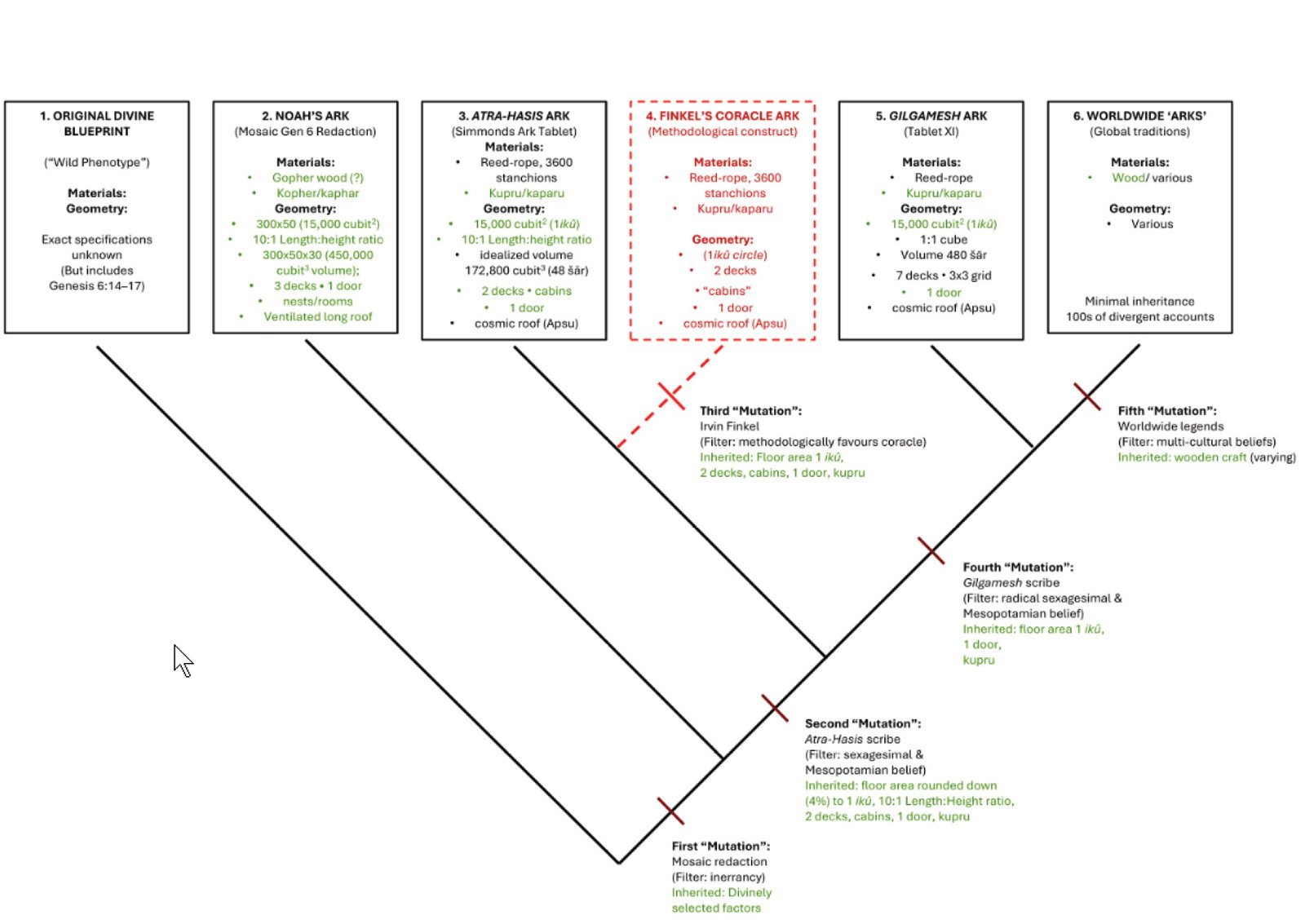
Fig. 10. Textual cladogram of Ark configurations. The descent from biblical inerrancy to sexagesimal and cosmic idealism and beyond.
As fig. 10 demonstrates, the Babylonian accounts do not represent an independent or purely localized invention of the flood vessel; rather, they exhibit the clear inheritance of traits—geometry and material science. Simmonds Flood Tablet inherited from Noah’s Ark its 10:1-dimensional ratio (length:height), its single door, and the kupru sealant, but subjected the floor area to a slight (4%) mathematical rounding-down to achieve the idealized 1 ikû footprint (from Noah’s Ark floor area of 15,000 sq cubits to 14,400 sq cubits). Its volume was subjected to sexagesimal idealism. By the time the text reaches the Gilgamesh tradition, the original 10:1 ratio is entirely corrupted into a 1:1 cosmic cube with seven decks, although the idealised base of 10 × 10 nindan was conserved.
Furthermore, this phylogenetic tracking isolates Finkel-AH as a distinct morphological dead end. By forcing the 1 ikû footprint into a circle, Finkel’s methodological filter destroys the last remaining inherited proportion of orthogonal length-to-width symmetry and introduces non-integer sexagesimal fractions into a tradition that otherwise strictly adheres to integer-based sexagesimal idealism. Ultimately, as the tradition disperses into the worldwide flood legends, almost all original structural “DNA” is lost to multi-ethnic religious influences, leaving the Genesis redaction as the most faithfully preserved textual witness preserver of the original unmutated, engineered “wild phenotype.”
Finkel-AH anomaly: Severing the phylogenetic chain
If the Rectilinear-AH ark is the mathematical “missing link” between historical reality and mythic hypertrophy, Finkel’s “Round Ark” hypothesis represents a catastrophic phylogenetic dead end. Inserting a Finkel-AH into this textual descent shatters the hereditary DNA of the narrative at its source and robs Noah’s Ark of an incidental historic witness:
- The eradication of orthogonal proportions: A circular vessel inherently lacks a distinct length and width. By interpreting the ark as a round coracle, Finkel eliminates the independent length-to-width symmetry and (4%) rounded-down floor area (1 ikû) that perfectly links Noah’s Ark to the Babylonian tradition.
- The destruction of sexagesimal holiness: As established, rounding the historical footprint to a 1-ikû (“field”) square produces a volumetrically pristine 48 šār. Forcing that same 1-ikû area into a circular hull yields non-integer sexagesimal values, resulting in chaotic fractional remainders. Finkel’s model completely perverts the base-60 theological idealism that motivated the scribal alterations in the first place.
- Severing the Gilgamesh link: The morphologic leap from the Atra-Hasis text to the Epic of Gilgamesh relies on a straightforward 10 × vertical inflation (extruding a 10 × 10 × 1 nindan square into a 10 × 10 × 10 nindan cube, perfectly inflating the volume from 48 to 480 šār). It is impossible to mathematically or architecturally extrude a Finkel-AH into a perfect cosmic cube. A round Atra-Hasis ark destroys the hereditary “DNA” required to birth the Gilgamesh ark.
Ultimately, Finkel’s interpretation is not merely an engineering fallacy; it is a textual aberration. A round ark isolates the Simmonds Tablet entirely, divorcing it from its historical predecessor (Noah’s Ark) and abruptly severing the lineage to its mythological successor (Gilgamesh). The trajectory of the data only flows in one direction: from the physical reality of Noah’s Ark as described Genesis 6:14–17, into the sexagesimal transition of a square-based ark in Atra-Hasis, and finally into the cubic, cosmic mythology of Gilgamesh.
Comparative Results
Table 3 summarizes the complete failure of the circular hypothesis when subjected to rigorous metrological scrutiny (all values provided in original scribal units).
| Variable | Natural Tablet Text (Square/Cube) | Finkel’s Interpretation (Idealized Circle) | Comparative Verdict |
|---|---|---|---|
| Floor Area | 100 sq nindan | 100 sq nindan | Finkel-AH model complies with area only by expanding its diameter to 11.28 nindan, rendering the 10-nindan structural ribs obsolete. Rectilinear model achieves perfect area-width concordance. |
| “Length and Breadth equal” | Side = 10 nindan | Derived Hull Radius ≈ 5.64 nindan | Coracle requires a non-terminating decimal radius. Square model yields a perfect integer. |
| Rib Length | 10 nindan | 10 nindan | Coracle forces geometric contradiction (see Span Deficit). Square model achieves 1:1 span. |
| Span Deficit (Flat Profile) | Hull Width = 10 nindan. Gap: 0.00 (Perfect Fit) | Required: 11.28 nindan. Gap: –1.28 nindan | Structural failure: Straight ribs are mathematically too short to construct the required circular area. |
| Span Deficit (Curved Profile) | Hull Height = 1 nindan. Gap: 0.00 (Perfect Fit) | Required: 11.52 nindan. Gap: -1.43 nindan | Structural failure: Curved ribs are physically incapable of spanning the required 10-nindan width. |
| Rope Volume | 14,400 sūtu (yields exactly 4 šār) | 14,430 sūtu (Textual data; theoretical circle requires ~14,648 sūtu) | Circular profile requires a non-integer sexagesimal fraction (~14,648 sūtu). Square model aligns with exact integer (4 šār). |
| Bitumen Volume | 28,800 sūtu (Exactly 8 šār) | Non-integer fraction | Circular profile yields non-integer sexagesimal fraction. Square yields exactly 8 šār. |
| Coating Coefficient | 120 (2 soss) per unit | 122.318... (Non-integer value) | Circular profile yields fractional 122.318... Square yields perfect sexagesimal integer (120). |
| Parallel Texts (Tablet XI) | 10 nindan base | N/A | Coracle catastrophically severs textual lineage. Square perfectly aligns with Gilgamesh footprint. |
Table 3. summarizes the complete failure of the circular hypothesis when subjected to rigorous metrological scrutiny (all values provided in original scribal units).
Conclusion
The “Round Ark” of the Simmonds Tablet is a modern phantom produced by Finkel’s rigid prioritization of a circular interpretation of kippatum over the precise, internally consistent mathematical data of the text. By mistaking the draftsman’s geometric construction method for the final plan, Finkel forces a rational, square-based text into an irrational, circular mould. A forensic audit of the tablet confirms the following:
1. Geometry (double-bind):
The internal dimensions present a geometric double-bind that renders a round hull physically impossible in any configuration.
- The area deficit (flat profile): If the 10–nindan ribs are laid flat to span a diameter, they generate a circular area of only ≈ 78 sq nindan, failing the text’s explicit requirement of 100 sq nindan (1 ikû.
- The span deficit (curved profile): If the ribs are curved to form a traditional coracle hull of the stated 1–nindan height, the “shortest path” theorem dictates that they can only span a width of 9.76 nindan (or 9.85 nindan in the area-compliant model), failing to reach the required hull boundaries in either configuration.
The structural rib length, vessel width, and total area constraints only align in perfect concordance within a square vessel.
2. Forensic audit (sexagesimal parsimony):
The material quantities reveal a rigid adherence to sexagesimal perfection that is only possible with a rectilinear geometry. The total bitumen volume of 28,8000 sūtu represents exactly 8 šār, yielding a perfect application rate of 120 sūtu per square nindan when applied to a square hull. In contrast, applying this volume to Finkel’s circular hull requires the use of non-terminating decimal values and results in chaotic decimal remainders. Finkel’s technical report explicitly admits that if the Babylonian scribes simplified the calculation by visualizing a square footprint, the total required rope volume is “14,400 sūtu . . . four šār exactly,” representing a negligible 0.2% variance from the tablet’s text. Finkel concludes that this “‘square-based’ method was almost certainly how the Babylonian scribes ‘back engineered’ their figure for the volume involved given the shape” (Finkel 2014, app. 3, 8). This concession confirms that the scribe relied on rectilinear geometry to derive the material totals.
3. Metrology:
The text describes a perfect 10–nindan square, identical to the base dimensions found in the Epic of Gilgamesh. Both traditions adhere to the same sexagesimal footprint (10 × 10), differing only in vertical extrusion (10 nindan Cube vs. 1 nindan high Barge).
4. Philology:
The term “parsiktu” places the technical vocabulary of the Ark Tablet within the same scribal milieu as the Babylonian Map of the World, suggesting a thematic alignment with the “Ararat” tradition of the northern mountains, not the Finkel-AH tradition of Iraq’s southern marshes.
5. Seaworthiness:
While the biblical dimensions (300 × 50 × 30 cubits) present a hydrodynamically stable 6:1 ratio verified by modern numerical naval architecture modeling (Hong et al. 1994; Lovett 2024), the Babylonian tablets describe a geometric abstraction (a cube or square barge) that is structurally unstable and highly prone to capsizing in a realistic seaway. Historical structural dynamic analyses further demonstrate that the rectangular cross-sections explicitly dictated in the Genesis account maximize structural stability, vessel strength, and safety in heavy seas, maintaining positive righting levers up to extreme angles of heel (Morris 1975). In stark contrast, a circular hull profile or spherical plan lacks any keel, deadrise, or skeg to provide directional tracking or roll damping features. Without independent means of stabilization, a massive Finkel-AH subjected to open-ocean hydrodynamic forces would suffer violent, unmitigated rotational and translational accelerations. This severe motion would cause catastrophic physical trauma to the inhabitants, making the vessel’s interior entirely uninhabitable for human and animal occupants alike (Horstemeyer et al. 2008; 2013).
Final verdict
Finkel’s hypothesis does not debunk Noah’s Ark as described in Genesis 6:14–17; rather, it highlights the difference between the corrupted, mathematically idealized tradition of Babylon and the realistic, historical engineering blueprint of Genesis. The Atra-Hasis Ark was a square-planned theoretical construct, mathematically idealized by the scribe to mirror the perfect dimensions of the cosmos as understood by the Mesopotamians, not a riverine coracle.
Finkel’s “Round Ark” hypothesis fails not only as an engineering construct but as a literary artifact. Beyond the geometric impossibility of its structural ribs, a circular interpretation profoundly disrupts the metrological continuity observed across the primary Near Eastern flood lineages. By tracking the metrological DNA—specifically the survival of the 10:1 length-to-height ratio, it’s (4%) rounded down footprint (1 ikû) and the deliberate sexagesimal volume inflation from 48 to 480 šār—it is evident that the Rectilinear-AH ark exemplifies a key intermediate stage of metrological design within the cuneiform tradition, illustrating the conceptual trajectory away from the historical engineering blueprint of Noah’s Ark and toward the mythic hypertrophy of Gilgamesh. Finkel-AH obliterates these hereditary markers, proving that the Old Babylonian scribes did not record a round riverboat, but rather sexagesimally idealized a square one.
In support of his evolutionary progression from Coracle to Noah’s Ark, Finkel states the following:
the procession from circle to square and square to oblong within a single continuum, at first indigestible and incompatible, becomes explicable, and to my mind reinforces the linear descent from cuneiform into Hebrew, the tracing of which represents the core of the present work. (Finkel 2014, 243)
Nevertheless, Finkel’s assumed evolutionary progression fundamentally misunderstands the entropy of textual transmission. To suggest that a geometrically impossible, riverine coracle (the circle) gradually “evolved” into a mathematically idealized, unseaworthy cosmic cube (the square), and then somehow was accidentally refined into a hydrodynamically stable, highly functional 6:1 seaworthy barge (Noah’s Ark) defies both engineering logic, textual transmission, and common sense.
It is vastly more probable that the transmission occurred in reverse. The highly specific, engineered reality of Noah’s Ark represents the historical “wild phenotype.” As this historical account dispersed into the Babylonian culture, scribes systematically stripped away the functional engineering to force the vessel into their own rigid, culturally prioritized moulds. The Mesopotamians did not invent a primitive coracle that the Hebrews later rationalized; rather, the Babylonians mathematically idealized a real-world engineering plan to fit their sexagesimal and cosmic worldview.
Finkel’s “Round Ark” hypothesis is, quite literally, an attempt to fit a square peg into a round hole. Furthermore, by forcing the text into a circular mould, uproots Noah’s Ark from its rightful place at the base of the phylogenetic tree of later Mesopotamian flood traditions.
Ultimately, the broader phylogenetic tracking of the Ark’s structure and dimensions (fig. 10) reverses the conventional critical narrative. As my textual cladogram demonstrates, the Genesis account is not a late, “demythologized” rationalization of Babylonian folklore. Rather, the Mosaic redaction stands as the faithful preserver of the original, engineered historical baseline The Mesopotamian traditions—along with modern methodological constructs like Finkel-AH—clearly represent downstream mutations, where functional, historical “DNA” was systematically overwritten by sexagesimal idealism and Mesopotamian religious aspirations. This structural and metrological continuity firmly establishes the biblical dimensions not as a mythic invention, but as a preserved engineering reality.
Acknowledgments
I would like to thank Varoujan D. Amirkhanian (www.ararat717.com) for his comments on my pre-publication manuscript, and for the anonymous reviewers for their critical remarks.
References
Buckle, David. 2025. “The Babylonians and π.” British Journal for the History of Mathematics 40, no. 1 (January):1–32.
Chaffey, Tim. 2014. “Does a ‘Recently Deciphered 4,000-Year-Old Tablet’ Discredit the Genesis Account of Noah’s Ark?” Answers in Genesis (January 27). https://answersingenesis.org/the-flood/flood-legends/does-a-recently-deciphered-4000-year-old-tablet-discredit-the-genesis-account-of-noahs-ark/.
Cox, Gavin. 2021. “The Oldest Example of Applied Geometry in the World.” https://creation.com/en/articles/oldest-example-of-applied-geometry.
Finkel, Irving. 2014. The Ark Before Noah: Decoding the Story of the Flood. London, United Kingdom: Hodder & Stoughton.
Fridman, Lex. 2025. “Irving Finkel: Secrets of Ancient Civilizations, Noah’s Ark, and Flood Myths.” Lex Fridman Podcast #487 (December 12). https://youtu.be/_bBRVNkAfkQ.
George, A. R. 1992. Babylonian Topographical Texts. Leuven, Belgium: Departement Oriëntalistiek.
George, A. R. 2003. The Babylonian Gilgamesh Epic: Introduction, Critical Edition and Cuneiform Texts. Oxford, United Kingdom: Oxford University Press.
Hong, S. W., S. S. Na, B. S. Hyun, S. Y. Hong, D. S. Gong, K. J. Kang, S. H. Suh, K. H. Lee, and Y. G. Je. 1994. “Safety Investigation of Noah’s Ark in a Seaway.” Creation Ex Nihilo Technical Journal 8, no. 1 (April): 26–36.
Horowitz, Wayne. 1998. Mesopotamian Cosmic Geography. Winona Lake, Indiana: Eisenbrauns.
Horstemeyer, M. F., J. Sherburn, D. Polk, and Andy Bryant. 2008. “Structural Dynamic Stability of Noah’s Ark.” In Proceedings of the Sixth International Conference on Creationism. Edited by A. A. Snelling, 503–510. Pittsburgh, Pennsylvania: Creation Science Fellowship.
Horstemeyer, Mark F., Jinshu Shi, Sheldon Q. Shi, and Stephen Horstemeyer. 2013. “Evaluation of the Noah’s Ark: Wood Mechanical Properties Affected by Water Immersion.” In Proceedings of the Seventh International Conference on Creationism. Edited by M. J. Oard and J. K. Reed. Pittsburgh, Pennsylvania: Creation Science Fellowship.
Landless, Jason W. 2020. “The Mesopotamian Deluge Accounts: Neither History Nor Revelation.” Answers Research Journal 13 (September 30): 231–240. https://answersresearchjournal.org/mesopotamian-deluge-accounts/.
Liguori, N. 2022. “The Myth of the Flood Myth.” Answers in Genesis, April 20. https://answersingenesis.org/the-flood/flood-legends/myth-flood-myth/.
Lovett, Tim. 2024. “Noah’s Ark: Proportions of a Real Vessel.” Answers in Depth, August 9. https://answersingenesis.org/noahs-ark/proportions-of-a-real-vessel/.
Morris, H. M. 1975. “The Ark of Noah.” In Speak to the Earth: Creation Studies in Geoscience. Edited by G. F. Howe, 15–33. Grand Rapids, Michigan: Creation Research Society Books.
Secrets of Noah’s Ark. 2014. Directed by TVF International/Windfall Films for Nova/PBS. https://youtu.be/9qSADdCZizk.
Statham, Dominic. 2006. “The Real Noah’s Ark?” Creation Ministries Interational, 8 February. https://creation.com/en/articles/real-noahs-ark.


.jpg)