The views expressed in this paper are those of the writer(s) and are not necessarily those of the ARJ Editor or Answers in Genesis.
Abstract
This paper investigates an analogous relationship between cryptographic systems and biological genomes to evaluate the plausibility of life’s spontaneous origin. In a comparison of brute-forcing a modern encryption algorithm (AES-128), computational resources required to generate functional genomic sequences through non-random, sequential, directed processes are quantified. The research demonstrates that while AES-128’s key space is considered computationally secure against brute-force attacks based on extreme time frames, the information content of even the simplest autonomous genomes exceeds this cryptographic complexity by many orders of magnitude. Mathematical calculations reveal that generating even the simplest viable genome (Mycoplasma genitalium with 580,070 base pairs) through sequential, non-random permutation would require computational time vastly exceeding the deep-time estimated age of the universe of over 13 billion years, even when using optimistic assumptions about computational speed and the environment. These findings provide quantitative evidence that spontaneous formation of functional genomes through undirected processes is not only computationally infeasible in theoretical systems, but infeasible in practice based within the bounds of the observable universe, even when conducted in a conducive environment. This supports the conclusion that evolution from atomic components to even the simplest DNA genome cannot be explained through random chance.
Keywords: DNA Complexity, Cryptography, Information Theory, Genome, Computational Complexity, Origin of Life, Encryption, Probability Calculation, Bioinformatics
Introduction
The origin of life based on the atomic generation of molecular biological information systems, such as DNA, poses a fundamental challenge to naturalistic explanations of life’s emergence (Meyer 2009). While modern science has made remarkable strides in understanding the structure and function of DNA, fundamental questions remain regarding how such complex information systems could arise spontaneously in an undirected system. This paper approaches this question from the perspective of binary cryptanalysis, applying principles from cryptography and binary computational theory to quantify the informational content of genomes and assess the feasibility of their random generation (Damaševičius 2010; Jiang and Xu 2010).
Cryptographic systems are designed to secure information through mathematical transformations that are computationally infeasible to reverse without knowledge of specific keys. Modern encryption standards like the Advanced Encryption Standard (AES) with 128-bit keys are considered secure because the computational resources required to recreate the entire key space exceeds current technological capabilities by many orders of magnitude (Bogdanov, Khovratovich, and Rechberger 2011; Lenstra and Verheul 1999). This paper employs an analogy between cryptographic systems and biological genomes to evaluate the plausibility of life’s spontaneous origin by aligning secure cryptographic systems design to the precise sequences needed for functional genomes (Gehani, LaBean, and Reif 2004; Xiao et al. 2006).
This analysis examines both secular perspectives on the origin of life, which propose the progressive development of increasingly complex systems from fundamental (atomic) components over time, and biblical creation beliefs, which assert a point-in-time creation event. This directly investigates the biblical account that God created Adam as a fully developed human, as the complexity and time required for Adam’s progressive creation would render it computationally infeasible within the constraints of universal time and certainly beyond biblical, young-earth (Ham 2006), concepts of time. This is accomplished by evaluating the computational feasibility of molecule-to-man evolution by comparing the complexity of modern cryptographic systems with that of biological information systems (Dembski 2002; Yockey 1992).
By quantifying the informational complexity of genomes into binary terms, and then calculating the computational resources that would be required for their non-random, sequential generation, the hypothesis that functional genetic sequences could not arise through undirected processes can be tested. If the computational requirements exceed available resources by margins that render the process effectively impossible, this would provide strong evidence against spontaneous origin explanations and support the conclusion that designed information systems require an intelligent designer (Behe 1996; Meyer 2009).
By converting the informational complexity of genomes into quantifiable binary terms, the same computational methods used for brute-forcing cryptographic keys to the creation of complex biological information systems can be applied. If the computational requirements for decryption are infeasible even when considering a secular theory of 13.8 billion years of universal time, then it can be supposed that more complex systems would become increasingly infeasible with respect to their complexity. It should be noted that cryptography occurs in an environmental vacuum, allowing near perfect processing; this is opposed to DNA which requires an entire framework of supporting environmental and other conditions to merely exist, much less reproduce and thrive.
Methodology
Our methodology combines principles from cryptography, information theory, biochemistry, and genomics to quantify and compare the complexity of encryption systems and biological genomes (Motahari, Bresler, and Tse 2013). The computational requirements for breaking cryptographic systems through brute-force attacks are established, then similar analysis to the complexity of genomic sequences is applied.
Cryptographic analysis framework
There are two fundamental approaches used to bypass or break cryptographic systems: (1) exploiting algorithmic or system vulnerabilities, and (2) attempting multiple keys through brute-force generation (Kim, Han, and Jeong 2018). This paper focuses on the latter approach, as it provides a clear mathematical basis for comparison, while the former approach does not relate key generation to time, but to other factors unrelated to temporal factors. When attempting to decipher a cryptographic system through brute-force, the process involves systematically testing possible keys until the correct one is found. For this form of brute-force attack to be meaningful, the keys tested must be non-repetitive, typically following a logical sequence from the smallest to the largest possible key (Lenstra and Verheul 1999). While a random search algorithm is a more realistic model for unguided naturalistic processes attempting to reach a functional target within the search space, a random search inherently allows for repetitive sequence generation. This analysis deliberately employs a sequential, non-repetitive, brute-force algorithm which tests all sequences in a specific order without repetition. This method provides the missing built-in intelligence, or design, to grant the most efficient advantage to a naturalistic process or hypothesis. The demonstration provides that generating a functional genome is temporally infeasible even under artificially perfect, non-repetitive search conditions; therefore, the mathematical impossibility of a less efficient random search is effectively proven. The average time required to find a correct key is half the total time needed to generate every possible key; however, the entire key space may be generated for cryptographic comparison, as in hash digests or collisions where the entire key space is explored. While biological evolution might theoretically rely on incremental steps, the concept of irreducible complexity demonstrates that a minimum number of functional genes exist simultaneously for autonomous life, establishing a baseline threshold that behaves as an all-or-nothing requirement similar to an encryption key (Behe 1998).
To relate this to DNA, the entire biochemical and atomic composition of the effective parts of a genome are considered as a key space, where the goal is to generate a viable double-helix capable of forming a functional DNA structure with any genomic traits, satisfying minimal biochemical requirements (Abel 2024). This is distinct from generating a specific genetic sequence that encodes the precise traits of a particular human individual, which would require a unique, highly specific sequence within the key space (Jiang and Xu 2010). The viable DNA key space represents all possible sequences that meet atomic and biochemical constraints for a stable double-helix of that particular genus or species, not the organism-specific sequences that define a particular individual within that genus species (Bonnici and Manca 2016). It should be acknowledged that finding one specific functional sequence is mathematically more restrictive than finding any functional sequence; however, the ratio of functional to non-functional configurations in biological macromolecules remains astronomically small, maintaining the necessity for a vast key space search.
For symmetric encryption algorithms like AES-128, the security is directly related to the key size, which determines the number of possible keys that must be tested in a brute-force attack (Patil et al. 2016). The key space grows exponentially with key length, making exhaustive key space generation computationally infeasible beyond certain key sizes due to the enormity of time, even if every possible key could easily be systematically generated and tested. Time is the factor that is currently paramount to the brute-force determination of feasibility when cracking a large key. To illustrate this difficulty, calculations are performed of the time required to search the entire key space, at various rates of computational performance, establishing a baseline for comparison with calculating the possibility of generating every possible atomic structure within different levels of genomic complexity (Ali et al. 2020; Bogdanov, Khovratovich, and Rechberger 2011).
Genomic complexity quantification
To quantify genomic complexity, the information content of DNA sequences is analyzed in terms of base pairs, treating each base pair as a unit of information. Cryptographic base component hierarchy is established, as follows: Atoms → Molecules → Nucleotides → DNA Strand → Double Helix (Genes + Chromosomes). This allows for the number of atoms within each compound to be collineated with cryptographic bits.
This collineation takes a novel approach by equating the physical material content of DNA sequences in terms atomic composition to cryptographic bits. The assignment of one cryptographic bit to one atom is used to establish a simple comparative baseline by mapping physical dimensions to a digital format that may be easily quantified. A more rigorous information-theory approach to this calculation would indeed consider complexity using cross-entropy:
where qi is the distribution of all possible atoms i found in the DNA sequence and pi is the relative abundance and distribution of those atoms on earth. Under this interpretation, each atom corresponds to −log2pi bits of information, and K represents the expected number of bits of information for a randomly chosen atom along the DNA sequence; however, for the purpose of demonstrating overarching computational infeasibility, this analysis employs a simplified 1:1 ratio. This simplification still yields wait times so large that further refining of the exact bit-to-atom precision via cross-entropy is unnecessary to demonstrate the conclusion. To accomplish this, a hierarchy from atoms to the double helix is established, allowing the quantification of atoms within each component. This will show that genomic complexity, even of the smallest genomes, vastly exceed the informational key space of AES-128.
The relationship is established with AES-128, as AES-128 quantifies the uncertainty in a well-known digital key space that is broadly understood for its enormous size, while maintaining a basic structure. When related to DNA sequences, the sheer scale of atoms required to construct even the simplest self-contained genomes represent an entirely different dimension of enormity. The immense size of these genomes represent a material scale far larger than abstract cryptographic key lengths, making a calculation of time required for their creation relevant to the origin of life.
To demonstrate this relationship, the initial comparison considers Mycoplasma genitalium and Mycoplasma pneumoniae, which represent the smallest known autonomous genomes (Jiang and Xu 2010; Motahari, Bresler, and Tse 2013). After the computational complexity for the most simplistic genomes on earth are established, the much larger human genome is considered for comparison related to directed, non-repetitive creation to time. The total information content is calculated for these genomes and expressed in terms of a measure of unpredictability, which are aligned as bits, allowing direct comparison with cryptographic key spaces.
Computational feasibility analysis
To assess the feasibility of generating functional genomes through random processes, the time required to systematically generate all possible DNA sequences of various lengths at different rates of computation is calculated. Comparison time frames with established reference points, including the maximum estimated age of the universe according to conventional secular scientific understanding (approximately 13.8 billion years [Spiegel and Turner 2012]) and the biblical time frame of approximately 6,000 years (Mortenson 2009), are also established.
When analyzing the feasibility of a brute-force attack, it is important to consider both a system with realistic capabilities and one with the most advanced computing power available (Curtin 2005). By calculating the time required to break a system under both conservative and highly optimistic scenarios, including those involving modern supercomputers, it is possible to determine the upper limits of what is computationally possible within a given time frame. This allows the establishing of upper bounds on what is computationally possible within the available time frames for bit calculations based on cryptographic brute-forcing. It should be noted that natural processes would be orders of magnitude slower than even a conventional computer. To align this methodology with each genome, only the specific mechanisms related to discrete, definable, chemical attributes are used. This excludes continuous variables both required within and external to the genome. Proving that an exaflop supercomputer cannot brute-force the key space within the deep-time age of the universe guarantees that unguided natural chemistry, which is drastically slower, chaotic, and bound by molecular diffusion, is fundamentally incapable of doing so, even under the highly optimistic parameters granted in this analysis.
Results
Cryptographic complexity of AES-128
The AES-128 encryption standard uses a 128-bit key, creating a key space of 2128 possible keys (approximately 3.4 × 1038). To quantify the computational requirements for a brute-force attack on this system, calculate the time required to search the entire key space at various rates (Bogdanov, Khovratovich, and Rechberger 2011; Lenstra and Verheul 1999; Smart and Thomé 2021).
Computational feasibility AES-128 keyspace generation (high-end system)
To generate all possible keys for AES-128, a rate of sequential, non-repetitive bit generation can be calculated using almost any scale of bits per second desired. The calculations in fig. 1 establish the timelines required in seconds and years based on 1 million keys per second.
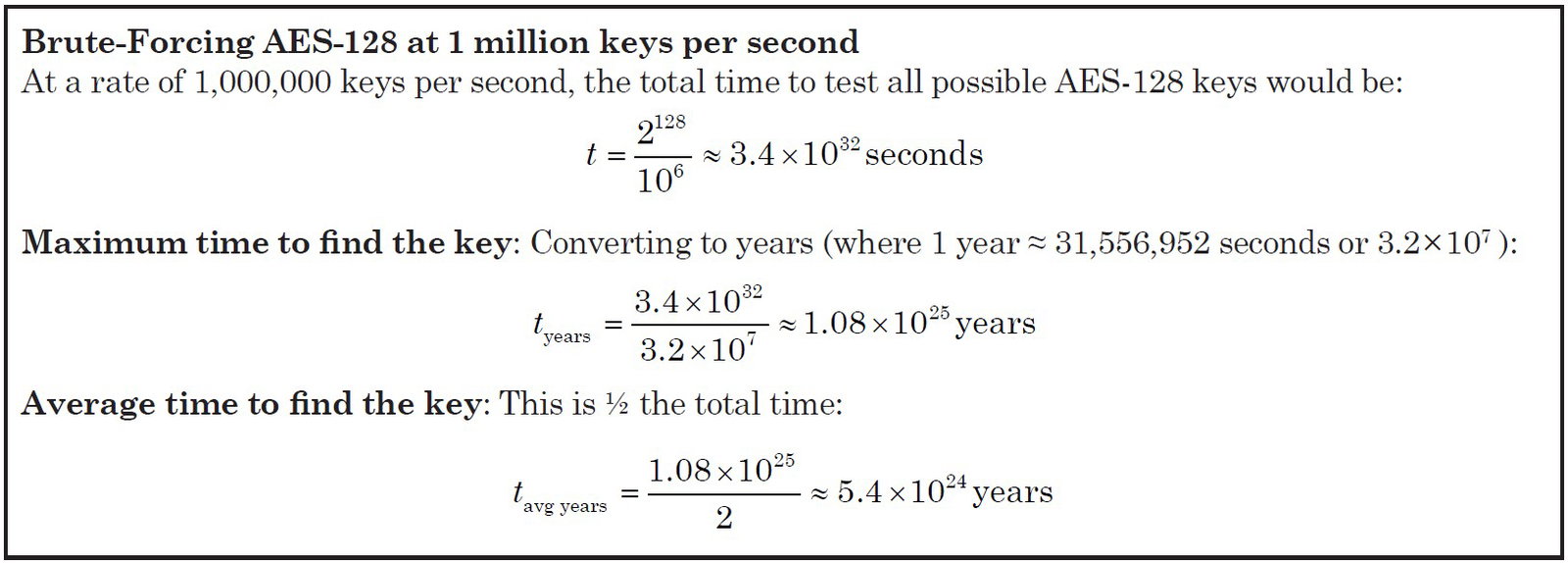
Fig 1. Exhaustive key search time estimates for AES-128 at a commodity baseline throughput ( 1.742 × 10⁶ keys/sec).
Computational feasibility AES-128 keyspace generation (El Capitan)
El Capitan is currently the world’s fastest supercomputer, with over 11 million combined CPU and GPU cores and a measured performance of 1.742 exaFLOPS (1.742 × 10¹⁸ floating-point operations per second) (Meissner 2024). The calculations in fig. 2 demonstrate a sequential, nonrepetitive generation at 1.742 exaFLOPS.
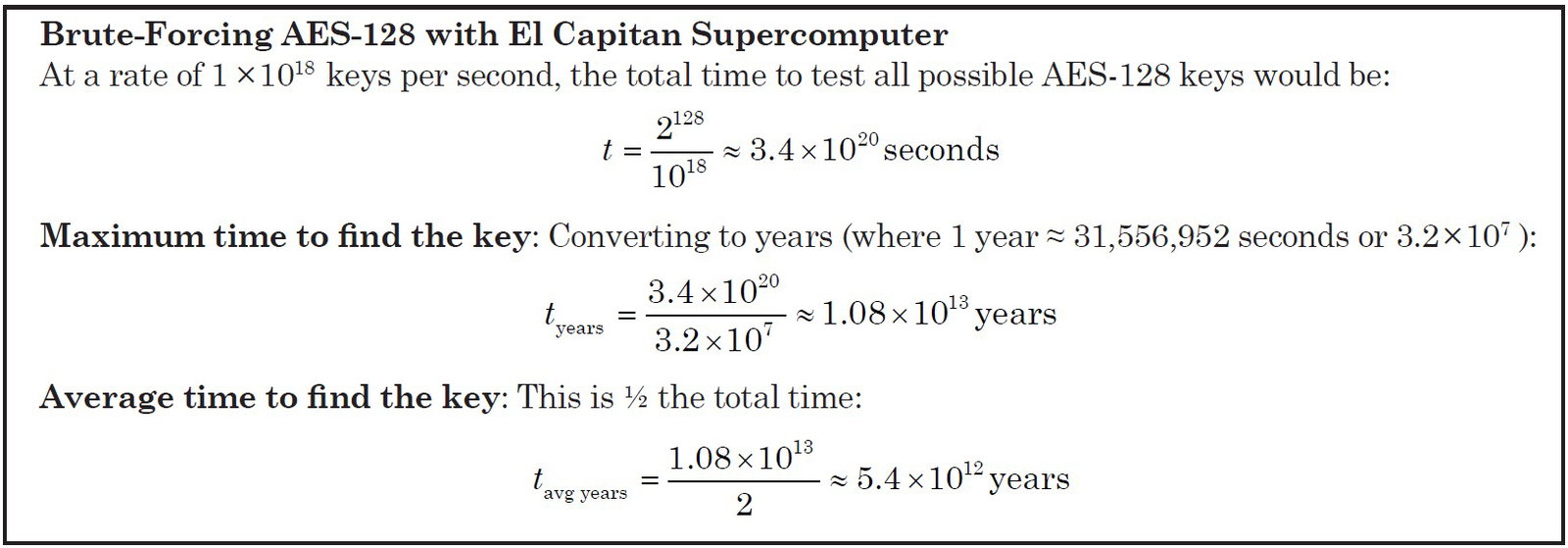
Fig 2. Exhaustive key search time estimates for AES-128 at exascale supercomputing throughput (1018keys/sec).
Taking into consideration modern supercomputing capabilities, the average time required to brute-force AES-128 would still be enormous, exceeding the conventional secular estimate of the universe’s age (13.8 billion years or approximately 1.38 × 10¹⁰ years [Spiegel and Turner 2012]) by a factor of nearly 400 times, making AES-128 effectively secure against brute-force attacks.
If this calculation is considered computationally infeasible due to universal time limits and processing capabilities, it would be logically consistent that more complex calculations would also be computationally infeasible. The following research applies this case when considering directed, sequential, non-repetitive, generation of genomes. It is also important to address non-directed, random, and repetitive genome generation that originates, not through a creator, but in a chaotic environment.
Complexity of Genomic Information
To align the genomic sequences of three representative species, a foundational understanding of the atomic complexity of DNA will be established. This enables the collineation of DNA tetramers (rungs) or four-base sequences to be compared to binary bits in cryptographic systems. Considering the composition of genomes as comprising Adenine (A), Cytosine (C), Thymine (T), and Guanine (G), if the phosphate is counted as PO4 (5 atoms), then removal of three –OH groups from the sugar (3 oxygens and 3 hydrogens) is required in order to form two sugar-phosphate linkages (one going “up” the DNA strand and one going “down” the strand) and one sugar-base linkage. Additionally, removal of one hydrogen from each of the bases is necessary to create the sugar-base linkage.
The atomic counts are represented in tables 1 and 2, and fig. 3, respectively.
| Base | Full Name | Chemical Formula | Type |
|---|---|---|---|
| A | Adenine | C5H5N5 | Purine |
| C | Cytosine | C4H5N3O | Pyrimidine |
| T | Thymine | C5H6N2O2 | Pyrimidine |
| G | Guanine | C5H5N5O | Purine |
Table 1. Summary of DNA bases.
| Base | Atoms (after removing 1H) |
|---|---|
| Adenine (A) | 14 |
| Cytosine (C) | 12 |
| Thymine (T) | 14 |
| Guanine (G) | 15 |
Table 2. Number of atoms in DNA bases (after removing 1H).
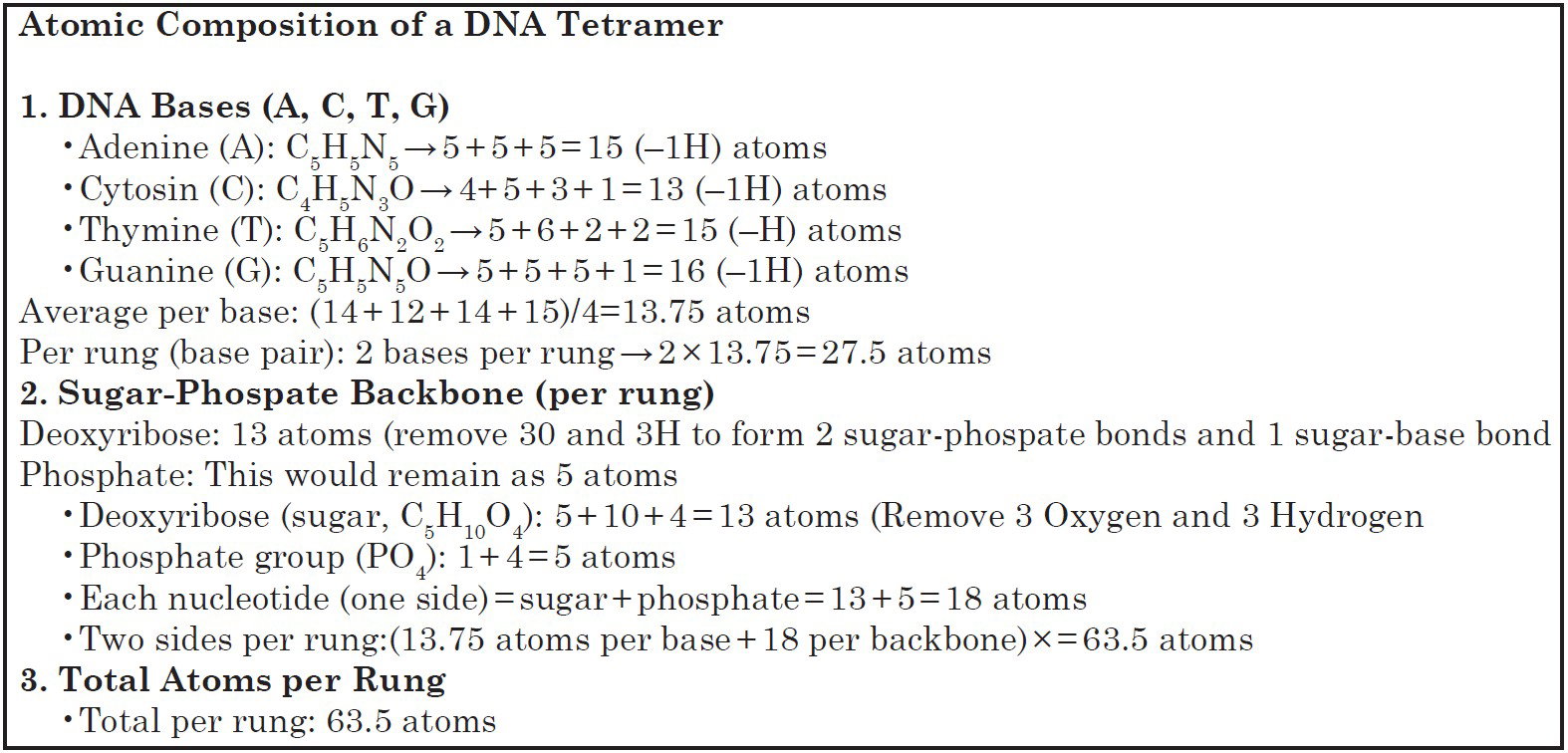
Fig 3. Atomic composition of a DNA tetramer.
Our analysis of genomic complexity focuses on three key examples that represent the minimum information content required to specify the complete genome sequences. Even at an initial glance, it is clear that these numbers vastly exceed the AES-128 key space of 2128, demonstrating that genomic complexity is many orders of magnitude greater than even strong cryptographic systems.
- Mycoplasma genitalium: 580,070 base pairs/comparative bits)
- Mycoplasma pneumoniae: 816,394 base pairs/comparative bits)
- Human genome: Approximately 6.4 billion base pairs / comparative bits)1
Computational Feasibility of Genome Generation
To assess the feasibility of generating functional genomes through directed processes, the time is calculated to systematically generate all possible DNA sequences at a rate of 1 quintillion sequences per second (1018). This varies from secular viewpoints of origins, in that the calculations below are non-repetitive, sequential, and directed. In secular literature, the process of creation and the origin of life is random, repetitive, and undirected. This section discussion non-ergodic key spaces, the improbability of chaotic origination of even the simplest form of life. The keyspace generation is processed based on speeds from the El Capitan Supercomputer at 1018 bits per second (bps). In order to clarify this analogy, we are utilizing this supercomputer’s processing speed to establish an artificially high benchmark compared to natural chemical reaction rates, or possibly quantum time intervals. This serves to establish a theoretical upper limit that facilitates our direct comparison with cryptographic key spaces. In this comparison, we are giving the undirected processes of nature an unrealistic mathematical advantage. We are calculating what would happen if nature could build and test genetic sequences as fast as the world’s most advanced supercomputer processes data. We hope by demonstrating that even at impossibly high speeds for natural design, there is still not enough time in the universe’s history to randomly generate a viable genome. In so doing, we hope to draw the logical conclusion that it is entirely impossible to create a genome at the much slower, actual rates of natural chemical reactions.
It must be noted that these baseline calculations assume the target is a single specific functional sequence (M = 1) out of all possible sequences (N). In reality, the set of all viable functional sequences (M) is greater than 1. While assuming M = 1 maximizes the expected waiting time, acknowledging a larger target set does not resolve the mathematical infeasibility. The search probability (M/N) and the corresponding active information (IA = −log2(M/N)) required to locate any functional sequence within the keyspace remains astronomically prohibitive (Dembski and Marks 2009; Díaz-Pachón and Hössjer 2022). Calculating the exact value of M for a viable genome is currently beyond empirical biological limits, but even highly generous estimates of M do not reduce the required time to computationally feasible levels.
Analysis
Comparison of Cryptographic and Genomic Complexity
Our results demonstrate that the informational complexity of even the simplest autonomous genomes far exceeds that of modern cryptographic systems considered computationally secure. This comparison provides a quantitative basis for understanding the challenge posed by the origin of biological information.
The key space of M. genitalium is approximately 21.16 × 10⁶, which is vastly larger than the approximately 1080 atoms estimated to exist in the observable universe. This demonstrates that even with the entire universe’s resources dedicated to the task, generating a specific functional genome through random processes would be impossible. This comparison is represented in Table 3.
| System | Size Collineation | Approximate Years |
|---|---|---|
| AES-128 | 128 bits | 1038 |
| M. genitalium | 36,834,445 bits | 1011,000,000 |
| M. pneumoniae | 51,841,019 bits | 1015,605,684 |
| Human DNA | 406,400,000,000 bits | 101,350,031,577,563 |
Table 3. Comparison of cryptographic and genomic complexity.
Temporal Constraints on Evolutionary Processes
The time required to systematically generate all possible DNA sequences for even the simplest autonomous genome far exceeds the deep-time estimate of the universe’s age (13.8 billion years) by many orders of magnitude.
This is illustrated in a comparison of complexity for Mycoplasma genitalium (fig. 4), Mycoplasma pneumoniae (fig. 5), and the Human Genome (fig. 6). For Mycoplasma genitalium, the simplest known organism capable of independent life with 580,070 base pairs, the time required to generate all possible sequences at a rate of 1,000,000 sequences per second would be approximately 21,159,900 years. This is a number so large that it cannot be meaningfully expressed in conventional notation. This would be approximately a 2 followed by 349,500 zeros, years.
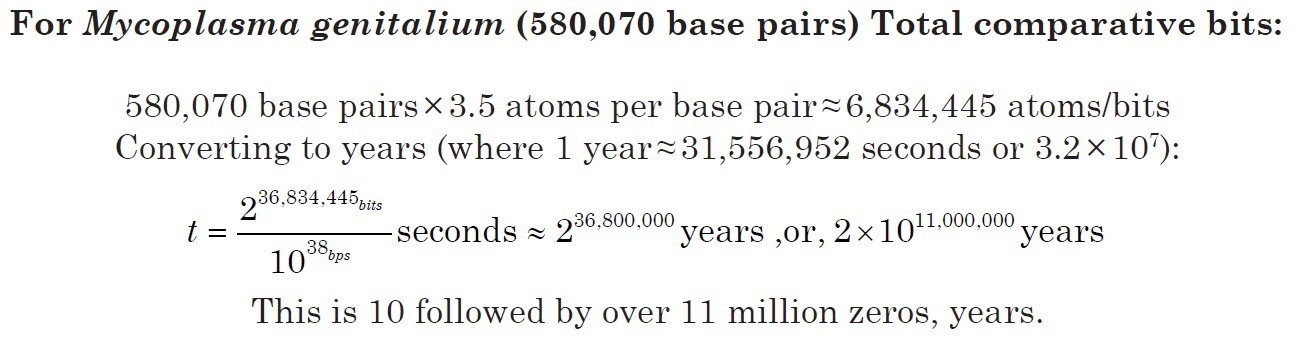
Fig 4. Mycoplasma genitalium.
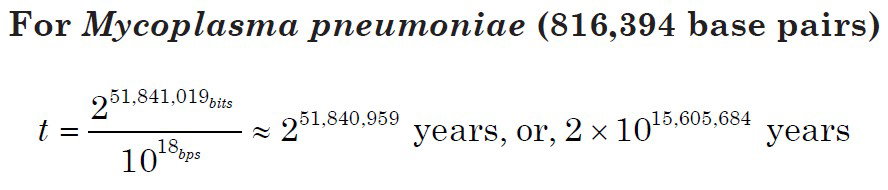
Fig 5. Mycoplasma pneumoniae.

Fig 6. Human Genome.
These calculations demonstrate that even with generous assumptions about computational efficiency, the generation of functional genomes through even directed, non-repetitive processes is temporally impossible within any reasonable time frame, whether conventional or biblical. This holds true across both ergodic and non-ergodic frameworks: the former is fundamentally barred by insurmountable time scales, while the latter faces physical limitations that prevent it from ever achieving the desired result at any computational speed.
Implications for Origin of Life Theories
This research has significant implications for naturalistic theories of the origin of life. The computational impossibility of generating functional genomes through random processes undermines scenarios that rely on undirected mechanisms to produce the specific information content required for life (Axe 2004; Dembski 2002; Gitt 1996). When faced with this information, scientists must differentiate between personal belief systems based on scientific analysis, and beliefs based on an unfounded refusal to acknowledge the possibility of a Creator God (Behe 1998; Meyer 2009).
It is also important to note that this analysis does not address all possible mechanisms required to support the formation, sustenance, and progeny of biological information within living systems. Living systems require additional factors beyond which any quantification can be established to be viable (Axe 2010; Lonnig 2004).
Theories that propose non-random processes that might reduce the keyspace, such as self-organizing chemical systems or natural selection operating on simple precursors, face their own challenges; including, the origin of the selection mechanism itself and the need for functional intermediates to maintain the system (Luskin 2015; Meyer 2004).
This analysis establishes that the generation of specific, functional genomic sequences through purely random processes is practically unfeasible within the available universal deep-time time frame (Dembski 1999; Gitt 1996). This is regardless of whether one adopts a conventional scientific timeline or a biblical one. This supports the conclusion that the origin of biological information requires a foundational instantiation of information in an initial non-random, directed process, consistent with creation by a Creator (Ham 2006; Meyer 2009; Ross 2001).
Discussion
Cryptography vs. Biology: Key Differences and Similarities
While this analysis draws a parallel between cryptographic systems and biological information, it is important to acknowledge both the similarities and differences between these scientific domains. Both domains involve complex, specified information that serves functional purposes; however, there are also important distinctions.
AES is designed for cryptographic secrecy and uniform entropy. DNA, while not engineered for security, encodes biological information with redundancy and additional structures to maintain a viable internal function. Yet in terms of pure combinatorial complexity, DNA is vastly more complex than symmetric encryption schemes like AES-128.
Another key distinction is that generating a viable DNA sequence requires not just the correct sequence of nucleotides but also the proper environmental conditions for folding, expression, and function. DNA requires water, moderate temperature, a near-neutral pH, stabilizing ions (such as Mg2+ or Na+), and protection from radiation or enzymatic degradation. These additional requirements further constrain the probability of spontaneous generation.
Beyond Simple Probabilities: Functional Constraints
This analysis considers solely the sequence of DNA and its complementary base pairing; however, it should be noted that for the sequences to occur in any period of time, much less in consideration of the correct order for functional genes, many environmental factors also must have been present at optimal levels. It should clear that none of these factors exist in its own vacuum to then be combined at a later point, instead, all of these conditional factors (and many others not noted here) must have been optimally present simultaneously for DNA to both form and function correctly. Therefore, these myriad conditions further increase the amount of pertinent information required for DNA.
Although this analysis focuses on the combinatorial complexity of generating specific DNA sequences, biological function introduces additional constraints that further reduce the probability of spontaneous generation. A viable organism requires not just a correct genome sequence but also:
- Proper protein folding for functional enzymes
- Coordinated expression of genes
- Functional metabolic pathways
- Cell membrane and structural components
- Mechanisms for replication and repair
- Environmental and biochemical compatibility, including:
- – Stability of DNA double-helix only within specific temperature ranges (denaturation above 95°C)
- – Appropriate ionic conditions, such as sufficient magnesium (Mg2+) for replication and repair, and sodium (Na+) for dissolution in water
- – Sensitivity to pH, radiation, and other environmental factors essential for sustaining life (Bai et al. 2007).
Each of these requirements introduces additional layers of complexity that would further reduce the probability of spontaneous generation. The protein folding problem alone represents a significant computational challenge, with many proteins having vast numbers of possible conformations but only a few that are functionally viable.
The Mathematical Futility of Random Search at Any Speed
To address questions about the inclusion of multiple universes or increased computational speed that would make these large calculations more conceivable, it is important to analyze the mathematics of a true random search. From a secular scientific viewpoint, the organization of molecules to life is an unplanned, undirected, random, and repetitive process (Gitt 1996; Meyer 2004).
While our baseline calculations utilize a non-repetitive brute-force algorithm with an expected waiting time of , an unguided naturalistic mechanism operates as a random search with replacement. A pure random search algorithm is ergodic, meaning it will eventually explore the entire key space uniformly over time. As such, its success probability after t seconds is and its expected waiting time is .
This mathematically demonstrates that an unguided random search requires exactly twice the expected waiting time as a sequential, “intelligent” brute-force attack. Because the expected time for the brute-force method already exceeds the secular estimated age of the universe by millions of orders of magnitude, doubling that required time for a realistic random search further reinforces the practical futility of spontaneous generation.
It is not necessary to introduce extreme non-ergodic inefficiencies (where a system might theoretically generate highly clustered, repeated guesses at a rate of 1 unique configuration per 10,000 attempts) to prove the computational impossibility. Even assuming a perfectly distributed, ergodic random search, the required time frames remain mathematically futile, even with computational capabilities far beyond current technological limits (Dembski 2002; Gitt 1996). This aligns with broader findings in information theory and design inference, where the improbability of functional sequence discovery without guidance is documented as impossible within realistic time frames (Axe 2004; Dembski 2002; Gitt 1996).
Response to Potential Objections
One potential objection to this analysis is that natural selection might provide a mechanism to reduce the search space by preferentially preserving functional intermediates; however, this objection faces several challenges:
Natural Selection This argument already requires a replication mechanism, which itself would need to emerge spontaneously before selection could operate. This creates a circular dependency that undermines the explanatory power of natural selection for the origin of the first replicators (Behe 1998; Cairns-Smith 1966; Fry 2011; Meyer 2009).
ex nihilo nihil fit Even with selection operating, the initial generation of functional sequences would still face the combinatorial challenge identified. Selection can only act on existing variation; it cannot create new information from nothing (Axe 2004; Dembski 2002; Gitt 1996).
Multiverse While infinite time mathematically dictates that any event with a non-zero probability will eventually occur, scientific analysis must remain grounded in the practical boundaries of our observable universe (estimated at 13.8 billion years). Within these empirical limitations, the time frames render the scenario effectively unfeasible (Collins 2003; Pross 2012; Ross 2001).
RNA World Hypothesis The prevailing view is that life began with self-replicating RNA molecules, which could both store genetic information and catalyze chemical reactions. DNA is thought to have appeared later, as a more stable repository for genetic information, after RNA-based systems had already evolved basic replication and metabolic functions (Alberts et al. 2002; Fine and Pearlman 2023; Meyer 2004; Robertson and Joyce 2012).
Hybrid Models Some recent research suggests that both RNA and DNA building blocks could have co-existed and formed under prebiotic conditions, but this does not imply that a fully-viable DNA genome emerged spontaneously. Rather, it suggests a possible chemical pathway for DNA to appear after or alongside RNA, still requiring many evolutionary steps to reach a fully functional genome (Fine and Pearlman 2023; Meyer 2004; Robertson and Joyce 2012).
Quantum Computing Parallels An evolutionary objection might argue nature operates similarly to a quantum computer; however, breaking algorithms relies on deliberate mathematical operations directed toward a specific target. Unguided evolutionary mechanisms lack the deterministic algorithms required to collapse parallel possibilities into a functional biological solution.
Stepwise Evolution All major models agree that the complexity of modern DNA-based life arose through a series of small steps: formation of simple organic molecules, emergence of self-replicating RNA, compartmentalization within membranes, development of metabolic pathways, and eventual transition to DNA as the main genetic material (Alberts et al. 2002; Minnich and Meyer 2004; Wells 2006).
Protocell and Metabolism-First Models Some models emphasize the role of primitive cell-like structures (protocells) and metabolic networks, but these also require many intermediate stages before DNA-based life could emerge (Behe 1998; Robertson and Joyce 2012).
While models such as the RNA world, hybrid nucleic acid scenarios, and stepwise evolutionary frameworks attempt to address the origin of genetic material, they all presuppose that complex molecules—whether RNA, DNA, or their precursors would spontaneously assemble in the correct amounts, sequences, and functional conformations within an ideal environment, all while avoiding degradation, side reactions, and decay; this assumption glosses over the astronomical improbability of such precise and coordinated events occurring naturally without guidance or prior organization.
Theological and Scientific Implications
The implications for both a theological and a scientific understanding of origins extends to both the biblical understanding of creation and the technical understanding of probability for overwhelming complexity. From a theological perspective, it provides quantitative support for the biblical account of creation, demonstrating that the spontaneous emergence of complex biological information is computationally infeasible. From a scientific perspective, it highlights the need for theories of biological origins, complexity to extend beyond multiverse arguments, and precise environmental parameters to address the information problem directly. If undirected random processes cannot account for the generation of biological information, then directed processes, consistent with a Creator or Intelligent Designer, become a more valid explanation.
Conclusion
Nothing within this research departs from the foundational principles of scientific inquiry. On the contrary, it seeks to broaden the scope of investigation by allowing for a more comprehensive evaluation of potential explanations. This is especially true in cases where patterns of information, organization, and complexity exhibit characteristics associated with intelligence and purpose. These associations align with a growing recognition within the field of bioinformatics of the informational architecture inherent in DNA (Andrade and Sander 1997). DNA is not merely a chemical molecule, but a medium encoding information in ways comparable in structure to language and computer code. This phenomenon invites questions about the source and nature of such information (Ham 2006).
It is scientifically imperative that research is not artificially constraining explanations to strictly materialistic processes, but permits the consideration of hypotheses that account for the observable signature of a designer. This simple comparison demonstrated the complexity in what is termed, “simple” DNA, in such a way as to express that certain features of biological systems are best explained by an intelligent designer rather than undirected processes alone. This viewpoint is supported by several individuals who have conducted research and investigation into the origin of life outside of this novel example (Axe 2010; Dembski 1999; Meyer 2009; Dembski 2002; Luskin 2015). If scientific inquiry follows the data wherever it leads, even if it leads to conclusions that intersect with metaphysical or supernatural implications, then the inquiry is further improved, not distracted. The research neither abandons nor compromises scientific rigor; rather, it restores to science the freedom to consider a wider range of logically possible explanations, especially when such explanations are warranted by the data.
Acknowledgments
We would like to acknowledge the support and contributions of Dr. Steven Lippold, Dr. Cody Work, and Mrs. Holly Poteete, M.Ed., and the multitude of reviewers for their help with this research.
References
Abel, David Lynn. 2024. Why is Abiogenesis Such a Tough Nut to Crack? Archive of Microbiology and Immunology 8, no. 3 (August 6): 338–364.
Alberts, Bruce, Alexander Johnson, Julian Lewis, Martin Raff, Keith Roberts, and Peter Walter. 2002. Molecular Biology of the Cell. New York, New York: Garland Science.
Ali, Khalid, Faheem Akhtar, Suhail Ahmed Memon, Anum Shakeel, Asif Ali, and Abdul Raheem. 2020. “Performance of Cryptographic Algorithms based on Time Complexity.” In Proceedings of the Third International Conference on Computing, Mathematics and Engineering Technologies (iCoMET). Edited by Dipak Kumar Jana, Mohd Helmy Abd Wahab, Park Gyei-Kark, and Prabir Panja, 1–6. Lahore, Pakistan: Institute of Electrical and Electronics Engineers.
Andrade, Miguel A. and Chris Sander. 1997. “Bioinformatics: From Genome Data to Biological Knowledge.” Current Opinion in Biotechnology 8, no. 6 (December): 675–683.
Axe, Douglas D. 2004. “Estimating the Prevalence of Protein Sequences Adopting Functional Folds.” Journal of Molecular Biology 341, no. 5 (August 27): 1295–1315.
Axe, Douglas D. 2010. “The Limits of Complex Adaptation: An Analysis Based on a Simple Model of Structured Bacterial Populations.” BIO-Complexity 2010, no. 4: 1–10. https://doi.org/10.5048/BIO-C.2010.4.
Bai, Yu, Max Greenfeld, Kevin J. Travers, Vincent B. Chu, Jan Lipfert, Sebastian Doniach, and Daniel Herschlag. 2007. “Quantitative and Comprehensive Decomposition of the Ion Atmosphere around Nucleic Acids.” Journal of the American Chemistry Society 129, no. 48 (November 9): 14981–14988.
Behe, Michael J. 1996. Darwin’s Black Box: The Biochemical Challenge to Evolution. New York, New York: Free Press.
Behe, Michael J. 1998. “Molecular Machines: Experimental Support for the Design Inference.” Cosmic Pursuit 1, no. 2 (March 1): 27–35.
Bogdanov, Andrey, Dimitry Khovratovich, and Christian Rechberger. 2011. “Biclique Cryptanalysis of the Full AES.” In Advances in Cryptology—ASIACRYPT. Edited by Dong Hoon Lee and Xiaoyun Wang, 344–371. Berlin, Germany: Springer.
Bonnici, Vincenzo, and Vincenzo Manca. 2016. “Informational Laws of Genome Structures.” Science Reports 6, Article no. 28840.
Cairns-Smith, A. G. 1966. “The Origin of Life and the Nature of the Primitive Gene.” Journal of Theoretical Biology 10, no. 1 (January): 53–88.
Collins, C. John. 2003. “The Case for an Intellect.” Perspectives on Science and Christian Faith 55, no. 4 (December): 279–283.
Curtin, Matt. 2005. Brute Force: Cracking the Data Encryption Standard. New York, New York: Copernicus Books.
Damaševičius, Robertas. 2010. “Complexity Estimation of Genetic Sequences Using Information-Theoretic and Frequency Analysis Methods.” Informatica 21, no. 1 (February): 513–538.
Dembski, William A. 1999. Intelligent Design: The Bridge Between Science and Theology. Downers Grove, Illinois: InterVarsity Press.
Dembski, William A. 2002. No Free Lunch: Why Specified Complexity Cannot be Purchased without Intelligence. Lanham, Maryland: Rowman and Littlefield.
Dembski, William A., and Robert J. Marks. 2009. “Conservation of Information in Search: Measuring the Cost of Success.” IEEE Transactions on Systems, Man, Cybernetics—Part A: Systems and Humans 39, no. 5: 1051–1061.
Díaz-Pachón, Daniel Andrés, and Ola Hössjer. 2022. “Assessing, Testing, and Estimating the Amount of Fine-Tuning by Means of Active Information.” Entropy 24, no. 10 (October): 1323.
Fine, Jacob L. and Ronald E. Pearlman. 2023. “On the Origin of Life: An RNA-Focused Synthesis and Narrative.” Frontiers in Molecular Bioscience 29, no. 8 (August): 1085–1098.
Fry, Iris. 2011. “The Role of Natural Selection in the Origin of Life.” Origins of Life and Evolution of Biospheres 41, no. 1 (February): 3–16.
Gehani, Ashish, Thomas H. LaBean, and John H. Reif. 2004. DNA-based cryptography. In Aspects of Molecular Computing—Essays Dedicated to Tom Head on the Occasion of His 70th Birthday. Edited by N. Jonoska, G. Paun, and G. Rozenberg, 167–188. Berlin, Germany: Springer.
Gitt, Werner. 1996. “Information, Science and Biology.” Creation Ex Nihilo Technical Journal 10, no. 2 (August): 181–187.
Ham, Ken A. 2006. The New Answers Book 1. Green Forest, Arkansas: Master Books.
Jiang, Yun, and Cunshuan Xu. 2010. “The Calculation of Information and Organismal Complexity.” Biology Direct 5, (12 October): Article number 59.
Kim, Panjin, Daewan Han, and Kyung Chul Jeong. 2018. “Time–Space Complexity of Quantum Search Algorithms in Symmetric Cryptanalysis: Applying to AES and SHA-2.” Quantum Information Processing 17 (31 October): Article number 339.
Lenstra, Arjen K., and Eric R. Verheul. 1999. “Selecting Cryptographic Key Sizes in Commercial Applications.” PricewaterhouseCoopers Cryptographic Centre of Excellence Quarterly Journal CCE Q. Journal 3 (Autumn): 3–9.
Lönnig, Wolf-Ekkehard. 2004. “Dynamic Genomes, Morphological Stasis, and the Origin of Irreducible Complexity.” Dynamical Genetics. Edited by Valerio Parisi, Valeria De Fonzo, and Filippo Aluffi-Pentini, 101–119. Kerala, India: Research Signpost.
Luskin, Casey. 2015. “The Top Ten Scientific Problems with Biological and Chemical Evolution.” Discovery Institute, February 20. https://www.discovery.org/a/24041.
Meissner, Caryn N. 2024. “‘Forward’ Projects Boost U.S. Leadership in Advanced Computing and Artificial Intelligence.” Technical Report LLNL-TR-864321. Lawrence Livermore National Laboratory (LLNL), Livermore, California.
Meyer, Stephen C. 2009. Signature in the Cell: DNA and the Evidence for Intelligent Design. San Francisco, California: HarperOne.
Meyer, Stephen C. 2004. “The Origin of Biological Information and the Higher Taxonomic Categories.” In Proceedings of the Biological Society of Washington 117, no. 2. Edited by Richard V. Sternberg, and Richard C. Banks, 213–239. Washington D.C.: Biological Society of Washington.
Minnich, Scott A., and Stephen C. Meyer. 2004. “Genetic Analysis of Coordinate Flagellar and Type III Regulatory Circuits in Pathogenic Bacteria.” In Design and Nature II: Comparing Design in Nature with Science and Engineering, Vol. 73. Edited by M. W. Collins, and C. A. Brebbia, 295–304. WIT Transactions on Ecology and the Environment. Southampton, United Kingdom: WIT Press.
Mortenson, Terry. 2009. “Systematic Theology Texts and the Age of the Earth: A Response to the View of Erickson, Grudem, and Lewis and Demarest.” Answers Research Journal 2 (December 16): 175–200. https://answersresearchjournal.org/systematic-theology-texts-age-of-earth/.
Motahari, Abolfazl, Guy Bresler, and David Tse. 2013. “Information Theory of DNA Shotgun Sequencing.” IEEE Transactions on Information Theory 5, no. 10 (October): 6273–6289.
Patil, Priyadarshini, Prashant Narayankar, D. G. Narayan, and S. M. Meena. 2016. “A Comprehensive Evaluation of Cryptographic Algorithms: DES, 3DES, AES, RSA and Blowfish.” Procedia Computer Science 78: 617–624.
Pross, Addy, and Robert Pascal. 2013. “The Origin of Life: What We Know, What We Can Know and What We Will Never Know.” Open Biology 3, no. 3: 120190.
Robertson, Michael P., and Gerald F. Joyce. 2012. “The Origins of the RNA World.” Cold Spring Harbor Perspectives in Biology 4, no. 5 (May): a003608.
Ross, Hugh. 2001. The Creator and the Cosmos: How the Greatest Scientific Discoveries of the Century Reveal God. 3rd ed. Colorado Springs, Colorado: NavPress.
Smart, Nigel P. and Emmanuel Thomé. 2021. “History of Cryptographic Key Sizes.” In Computational Cryptography. Edited by Joppe W. Bos and Martijn Stam, 314–334. Cambridge, United Kingdom: Cambridge University Press.
Spiegel, David S. and Edwin L. Turner. 2012. “Bayesian Analysis of the Astrobiological Implications of Life’s Early Emergence on Earth.” Proceedings of the National Academy of Sciences USA 109, no. 2 (December 22): 395–400.
Wells, Jonathan. 2006. The Politically Incorrect Guide to Darwinism and Intelligent Design. Washington, DC: Regnery Publishing.
Xiao, Guozhen, Mingxin Lu, Lei Qin, and Xuejia Lai. 2006. “New Field of Cryptography: DNA Cryptography.” Chinese Science Bulletin 51, no. 12 (15 June): 1413–1420.
Yockey, Hubert P. 1992. Information Theory and Molecular Biology. Cambridge, United Kingdom: Cambridge University Press.