
Research conducted by Answers in Genesis staff scientists or sponsored by Answers in Genesis is funded solely by supporters’ donations.
Abstract
Among biblical scholars, there is little debate over the length of Israel’s sojourn in Egypt. Nearly all who do comment on it believe Israel spent 430 years in Egypt, a view known as the long sojourn. Meanwhile, young-earth creationists often defend the short sojourn position that Israel was in Egypt for 215 years. Indeed, given their strong interest in the age of the earth and developing accurate models of earth’s past, it is imperative for creationists to examine the considerable biblical support for the long sojourn. This paper analyzes the relevant biblical passages and demonstrates that the Bible describes the long sojourn. Arguments for the short sojourn are evaluated and found wanting.
A unique contribution of this paper is the detailed treatment of the censuses recorded in Numbers 2–4. Rather than running basic calculations to reach a desired population in 215 years, advocates of both the short and long sojourn views must be able to account for numerous specific details in these censuses. This is not a difficult problem for long sojourn proponents since their 430-year window provides enough time to reach the necessary population at a rate consistent with the details of Scripture. On the other hand, those who hold to a short sojourn cannot account for many of the totals in Numbers 2–4 without appealing to growth rates that far exceed any other culture in human history.
Keywords: Israel, Canaan, Egypt, Exodus, biblical chronology, Israelite sojourn, long sojourn, short sojourn, Israelite census, population growth, textual criticism.
The modern biblical creation movement seems to have largely adopted Ussher’s popular chronology as an accurate portrayal of the biblical timeline (Mortenson 2020). This is demonstrated by the common claim that the flood occurred in 2348 BC (Griffith and White 2023; Sibley 2022) and the creation of the world around 4004 BC, dates that rely upon Ussher’s calculations and assume an Israelite sojourn in Egypt of 215 years.
Known as the short sojourn model, this 215-year period is rarely defended by biblical scholars today and seems to be at odds with multiple verses describing Israel’s sojourn as being about twice as long. For example, Exodus 12:40 states, “The time that the people of Israel lived in Egypt was 430 years.” Ussher stated that this 430-year period did not start when Israel entered Egypt; instead he argued that “it was exactly four hundred and thirty years from the first pilgrimage of Abraham’s departure from Canaan to the day they were set free from bondage” (Ussher 2003, 39). Short-sojourn advocates either follow Ussher or closely align with his interpretation of this passage, some differing in that they believe the 430 years began when Abram entered Canaan for the first time (Carter and Sanders 2021). Naturally, proponents of this position have offered a defense of their position by pointing to a few more passages that they presume offer support for their view. However, these arguments are not as solid as many believe. At the same time, they rarely seem to acknowledge the extensive biblical support for a long sojourn in Egypt of 430 years. As Christians committed to biblical authority, biblical creationists must be willing to change their views if they find them to be at odds with the Word of God.
This paper will examine the passages relevant to the sojourn debate in the order they appear in Scripture to demonstrate that the long sojourn is explicitly taught in Scripture. The question is not whether individual texts can be isolated in apparent support of either position, but which model best accounts for the entirety of the biblical evidence. The final section of the paper will focus on relevant details of the censuses described in Numbers 2–4 because they reveal multiple figures that seem irreconcilable with a short sojourn. Previous discussions have typically focused on aggregate population growth, whereas this paper evaluates whether specific census data in Numbers 2–4 can be reconciled with the sojourn models.
Passage 1: Genesis 15:13–16
The first passage in Scripture relevant to the sojourn’s duration is found in Genesis 15:13–16 (ESV).
Then the Lord said to Abram, “Know for certain that your offspring will be sojourners in a land that is not theirs and will be servants there, and they will be afflicted for four hundred years. But I will bring judgment on the nation that they serve, and afterward they shall come out with great possessions. As for you, you shall go to your fathers in peace; you shall be buried in a good old age. And they shall come back here in the fourth generation, for the iniquity of the Amorites is not yet complete.”
These verses contain several important points relevant to this discussion. First, the Lord told Abram that his “offspring will be sojourners in a land that is not theirs” (Genesis 15:13). The text specifically states that they would sojourn in “a land” (’erets). He used the singular noun אֶרֶץ instead of the plural אֲרׇצֹת (’araṣōt). By the end of Genesis and as documented in Exodus, we know that this land spoken of by God was Egypt, but the short sojourn requires that Canaan and Haran also be included in this single “land” in which Abram’s descendants sojourned.
The fact that God included the words “that is not theirs” provides another argument against the short sojourn since God had already promised Canaan to Abram (Genesis 13:14–17). While they would not occupy the land until the time of Joshua, it had already been given to Abram, so how could Canaan be included in “a land that is not theirs”? Technically, they did own some of the land ever since Abraham purchased “the field with the cave that was in it and all the trees that were in the field, throughout its whole area, was made over to Abraham as a possession in the presence of the Hittites . . .” (Genesis 23:17–18). And it was in this area where the patriarchs spent some of their time (see Genesis 25:9–10, 35:27, 37:1,14). Genesis 15:13–16 contrasts the land of their sojourn with the land of promise, so it is difficult to see how both Egypt and Canaan could be intended for the sojourn period as required by the short sojourn.
The Lord also told Abram that his descendants would be servants and be afflicted for 400 years. This can hardly be overemphasized: God stated that the Israelites would be servants in a land (Egypt), and they would be afflicted for 400 years, which is typically viewed as a round number. Notable exceptions to this would be John Rea and Harold Hoehner, who believed the 430-year clock began when Jacob returned to Canaan from Haran, and they viewed the 400 years as accurately predicting the number of years the Israelites spent in Egypt (Riggs 1971, 26). For most long sojourn advocates, the 400-year servanthood is linked to their time in another land, but if this period were only a small portion of the 215 years, as the short sojourn proposes, then how could this rightly be viewed as a fulfilment of God’s words to Abram? Furthermore, if the 400 years started during Abram’s time, as required by the short sojourn, then should not the “fourth generation” also start at that time instead of three generations later? The short sojourn treats these figures as referring to different time periods even though the context links them. The “400 years” is tied to the amount of time Abram’s descendants would be in a land that is not theirs, and the “fourth generation” refers to the time when they would leave that same land to return to the one God had given them.
Short sojourn advocates call attention to the “fourth generation” in verse 16 as evidence for their view (Carter and Sanders 2021). They point to Moses’ genealogy in Exodus 6 where it lists his genealogy from Jacob as passing down through Levi, Kohath, and Amram. This would put Moses in the fourth generation, although he did not technically return to the promised land, and it would be the generation after him that returned to the land. There are at least two problems with this approach. First, as pointed out above, the “fourth generation” should be understood as the same time frame as “400 years.” Second, where does the text state that the “fourth generation” would be a reference to Moses’ lineage? Genesis tells the narrative through Abraham, Isaac, Jacob, and Joseph, and after Moses passes away at the end of Deuteronomy, it picks up again with Joshua, the man who led Israel back into the land and lived ten generations after Joseph.
If generation in this verse means the average timespan between the birth of a man and the birth of his firstborn son during that era, then this could possibly be a valid critique of the long sojourn, since this type of generation was shorter than 100 years in Moses’ day. Thus, there would need to be more than four of these generations to span 400 years. However, the word translated as “generation” is דּוֹר (dôr), and it has a variety of meanings. It can carry the meaning described above, as it apparently does in Job 42:16, where Job saw his descendants to the fourth generation, which would yield an average generation time of under 40 years. However, this is not determinative for Genesis 15:16. Here, God told Abram how long four generations would last. Since Abram’s descendants would come back in the fourth generation and they would be in a foreign land for 400 years, then the most natural reading is that the four generations are equivalent to 400 years. Of course, this would mean that each generation was about 100 years, and this is precisely how old Abraham was when Isaac was born. Wenham agreed with this reasoning when he wrote, “Apparently the two periods are equated, so one generation equals 100 years” (Wenham 1987).
There is additional biblical support for this concept. The word appears in Genesis 7:1 (cf. Genesis 6:9) where it surely does not mean 40 years or anything close to that. God said that Noah was righteous before him in this generation. What generation? At that time, people lived over 900 years, and most of the patriarchs listed in Genesis 5 had begetting ages well over 100 years. For example, Noah was 500 years old, his father was 182, and his grandfather was 187. It would seem rather strange to impose a 40-year generation timescale on the pre-Flood patriarchs, so why impose it on the people of Abram’s time when they living close to 200 years (Abraham died at 175 and Isaac at 180)?
Finally, in Genesis 15:16, dôr may not even mean “generation” in the way described above. One of the most respected lexicons, The Dictionary of Classical Hebrew, lists this verse under the second definition of dôr where it is defined as an “age” or “period” (Clines 1993, 2:428). In his commentary, Mathews suggests that dôr “denotes a span of time, but not necessarily a fixed number of years” and since Isaac was born when Abraham was 100 years old, this equates four dōrōt (plural of dôr) with 400 years (Matthews 2005, 174–175). So, if dôr simply represents a period that is determined by its context, then there is no problem with the long sojourn perspective that each dôr represented about 100 years. Famed archaeologist and professor of Semitic languages William F. Albright stated that “the word dor did not mean ‘generation’ in early Hebrew, but ‘lifetime,’ like the Etruscan-Roman saeculum; the Arabic cognate dahrun often means ‘lifetime’ (originally ‘cycle’), Syriac dara is defined as ‘80 years,’ and the word darum appears in an inscription of Shamshi-Adad I of Assyria also in the meaning ‘lifetime’” (Albright 1963, 9).
Even if dôr is to be understood as representing four names in a genealogy, as short sojourn proponents claim, then which lineage is meant to represent the fulfilment of this promise? If the relevant genealogies do not contain gaps, as demanded by the short sojourn, then Moses was in the fourth generation, Nahshon was in the fifth generation and Bezalel was in the seventh generation in Judah’s line, Elishama was in the ninth generation from Jacob through Ephraim, and Nun was in the tenth generation in Joseph’s line (note also Merrill 1987, 78). What exegetical basis does one have for assuming that the Levi-to-Moses line is intended to be the fulfilment of Genesis 15:16? If any specific line was in view, one would expect it to be Judah since it was through his line that God would send the Savior in whom the families of the world would be blessed through Abraham.
Passage 2: Genesis 21:8–9
The account of Isaac’s weaning feast is sometimes cited by short sojourn supporters as evidence for their timeline. “And the child grew and was weaned. And Abraham made a great feast on the day that Isaac was weaned. But Sarah saw the son of Hagar the Egyptian, whom she had borne to Abraham, laughing” (Genesis 21:8–9).
Isaac was born when Abraham was 100 (Genesis 21:5). The next definite chronological marker is Sarah’s death at 127, which occurred 37 years after Isaac’s birth (Genesis 23:1). The text does not say precisely when this great feast was held. However, some supporters of the short sojourn say that this happened when Isaac turned five (Carter and Sanders 2021). This would have been 30 years after the first promise was given to Abram and 400 years before Israel’s exodus from Egypt, according to the short sojourn interpretation. However, five years old seems much too late for weaning. The famous martyrdom of seven brothers under Antiochus IV, recorded in 2 Maccabees 6–7 and likely alluded to in Hebrews 11:35, features their mother telling the youngest brother that she nursed him for three years (2 Maccabees 7:27). Children in the ancient world were typically weaned by the time they were two or three years old (Singer 1901). If this were a chronologically significant moment in Scripture, one would expect a specific time marker to be given instead of arbitrarily inserting a date when Scripture does not provide one.
Defenders of the short sojourn might point to Galatians 4:29 because it implies that Ishmael persecuted Isaac (Jones 1993, 58). However, when Paul mentioned this episode in Galatians 4:28–31, he was developing an illustration through the contrast of Ishmael/Hagar (son of the slave woman) with Isaac/Sarai (son of the free woman). While setting up this comparison between the two parties, he said that “this may be interpreted allegorically” (Galatians 4:24). We know that Hagar was not truly “Mount Sinai in Arabia” (verse 25) and Sarai was not really “the Jerusalem above,” but for the purposes of Paul’s allegory, Hagar represented those who believed they could attain righteousness by following the law as opposed to those who were of the free woman (Sarai) represented by those who were set free in Christ. And since the Judaizers were troubling the Galatian believers, they were likened to Ishmael’s mockery of Isaac. In making this case, Paul surely intended to offend the Judaizers by comparing them to Ishmael, even though they were physically descended from Isaac. One could make the case from Genesis that Ishmael was oppressed for Isaac’s sake. Sarai urged Abraham to “Cast out this slave woman with her son” (Genesis 21:8). Although it troubled Abraham to do it, he sent Hagar and Ishmael away, and were it not for God’s intervention, they would have died of thirst in the wilderness. Indeed, it is difficult to see how Ishmael mocking Isaac on the day of his weaning feast could be viewed as being part of the 400 years of oppression and servitude Abraham’s descendants would endure in a land that was not their own. Jones acknowledged this shortcoming by stating that “Isaac did not thereafter serve either the Egyptian bondwoman, her son or any other Egyptian” (Jones 1993, 59).
Passage 3: Exodus 6:16–20
This passage provides the Levitical lineage of Moses and Aaron with the respective fathers’ lifespans recorded, but it does not reveal the fathers’ ages when begetting the next in line.
These are the names of the sons of Levi according to their generations: Gershon, Kohath, and Merari, the years of the life of Levi being 137 years. The sons of Gershon: Libni and Shimei, by their clans. The sons of Kohath: Amram, Izhar, Hebron, and Uzziel, the years of the life of Kohath being 133 years. The sons of Merari: Mahli and Mushi. These are the clans of the Levites according to their generations. Amram took as his wife Jochebed his father’s sister, and she bore him Aaron and Moses, the years of the life of Amram being 137 years. (Exodus 6:16–20)
Another passage is also relevant here:
The name of Amram’s wife was Jochebed the daughter of Levi, who was born to Levi in Egypt. And she bore to Amram Aaron and Moses and Miriam their sister. (Numbers 26:59)
Short sojourn supporters cite these passages and believe that there are two arguments for their view in them. First, Exodus 6:16–20 seems to imply that Moses was the great grandson of Levi. However, since this brief genealogy does not include the begetting ages of these men, one cannot rule out the possibility of gaps from these verses alone.
Long sojourn advocates believe that at least one gap exists between these names to span the 400-year sojourn period. Genesis 46:11 states that Kohath was indeed Levi’s son, so there is not a gap in that generation. And Exodus 6:20 seems to imply that Amram was Moses’ father, so a gap probably cannot be inserted between these two men, but it is still possible given the flexibility of the Hebrew language regarding familial titles, such as father and son often meaning ancestor and descendant. The most likely relationship to insert a gap of approximately 300 years would be between Kohath and Amram (Cole 2000). It is also possible that Amram was Kohath’s son, but not the same man as Moses’ father who was also named Amram. It certainly is not uncommon for biblical genealogies to feature individuals of the same name in a single lineage. For example, in Jesus’ genealogy in Luke 3, there are four Josephs, three Judahs, two Matthats, and two Mattathiahs. This latter scenario would place a gap of several generations between two men named Amram (Riggs 1971, 30).
Supporters of the short sojourn believe this genealogy is closed, and that a direct father-son relationship exists between each of the people from Levi to Moses. Their best argument for this view is that Numbers 26:59 identifies Jochebed as a daughter of Levi. And if Moses’ mother is from the generation after Levi, then a four-century sojourn is impossible unless she lived during that whole period. This creates a dilemma for both positions. Long sojourn defenders must be able to explain how Moses’ mother was also a daughter of Levi and short sojourn proponents must be able to explain how in this same timeframe from Levi to Moses there were five generations listed for Judah (Judah, Hezron, Ram, Amminadab, Nahshon) and 11 generations from Joseph (Joseph, Ephraim, Rephah, Resheph, Telah, Tahan, Ladan, Ammihud, Elishama, Nun, Joshua). Of course, Joshua was about one generation after Moses.
The dilemma facing the long sojourn here appears to be formidable, at least in English, but for those familiar with conventions of the Hebrew language, this objection is easily handled. First, there are plenty of examples throughout Scripture where genealogies skip several generations. Matthew’s genealogy of Jesus famously skips multiple generations, as does Ezra’s genealogy in Ezra 7:1–5 where at least seven names are omitted from the genealogy in 1 Chronicles 6:3–15. And since the genealogy in Exodus 6 does not include begetting ages, one cannot rule out a gap, particularly if other biblical data demonstrates that a gap occurred between Kohath and Amram.
Second, phrases that usually connote immediate familial relationships in English (for example, father, mother, son, daughter, etc.) do not always imply immediate descent or ancestry. For example, in C. S. Lewis’ Narnia series, “sons of Adam” and “daughters of Eve” are terms used to describe very distant descendants of Adam and Eve. This practice is very common in the Hebrew Bible, as there are dozens of examples where someone is identified as the “son of” a certain person or a “daughter of” an individual when they were a more distant descendant. Also, when someone is said to be the “father of” someone else, there are examples where the individual is the grandfather or more distant ancestor of that person. Consider some of the following examples:
- Genesis 31:55—Jacob’s sons are called Laban’s “sons.” Some translations have “grandchildren” (ESV, NET, and NIV), which is an accurate designation, but the Hebrew word is the normal word for sons (benē).
- 1 Chronicles 9:4—Bani, who lived about the time of the Babylonian exile, is called a son of Perez, the son of Judah. This “son” lived more than 1,000 years after Perez.
- 1 Chronicles 26:24—Shebuel was a treasurer in the temple during Solomon’s reign, yet he is described as “the son of Gershom, son of Moses,” even though he lived nearly 500 years after Gershom.
- Genesis 6:2—The women identified as the “daughters of men” are literally called the “daughters of Adam” (benōt ha Adam) in Hebrew.
- Genesis 11:5 (“sons of men”) and Deuteronomy 32:8 (“mankind”) describe humanity as the “sons of Adam” (benē ha Adam) in Hebrew.
- Genesis 28:13—God identified Abraham as Jacob’s “father,” even though he was Jacob’s grandfather.
- 2 Kings 18:3—David is called Hezekiah’s “father” even though he lived approximately three centuries earlier and was Hezekiah’s distant ancestor.
This practice of referring to ancestors as “father/fathers” and descendants as “son/sons” or “daughter/daughters” carried over into the New Testament, where the very first verse identifies Jesus as “the son of David, the son of Abraham” (Matthew 1:1). Thus, it would not be unusual if Jochebed was a distant descendant of Levi even though she is called a “daughter of Levi” (Numbers 26:59). This fact would allow for a gap of several generations to exist between Kohath and Amram without contradicting any passage of Scripture.
If there was at least one gap between Levi and Moses, why would these men be listed while leaving out the other names in the proposed gap(s)? These names may have been selected because they corresponded to Moses’ tribe (Levi), clan (Kohath), and family (Amram).1 These designations were commonly used during the 40-year period following the Exodus.
Long sojourn defenders do not see the identification of Jochebed as a “daughter of Levi” or as being the sister of Amram’s father (Exodus 6:20) as being definitive since these terms are flexible in Hebrew. And there are at least three arguments derived from Scripture that seem to indicate that Jochebed could not have been Levi’s immediate descendant and Kohath’s sister. First, as discussed earlier, God told Abram that his descendants would be afflicted for 400 years in a land that is not their own. If Levi would have died around 41 to 55 years before Moses was born, as per the short sojourn view, then it contradicts the straightforward reading of Genesis 15:13. Second, as pointed out in the previous section, other lineages show many more generations occurring during the same years spanning Levi to Moses. Third, according to Numbers 3:27–28, 13 months after the Exodus, Moses’ ancestor Kohath had 8,600 male descendants (or 8,300 in the LXX) who were at least one month old. The population issues will be examined in the final section of this article, but if this genealogy is closed and Kohath was Moses’ grandfather, and we assume two more generations after Moses since he was 81 at this point, it means that Kohath and each of his surviving male descendants for four generations needed to average 9.6 sons, a figure that far exceeds the details provided in Scripture.
Finally, while many early interpreters favored the short sojourn there were exceptions. Clement of Alexandria (c. AD 150–215) wrote, “From Isaac to the division of the land, six hundred and sixteen years” (Clement of Alexandria [c. 200] 1885, 332). This total does not match the typical long sojourn figure, which would be about 50 years higher (190 years from Isaac’s birth to Egypt, 430 years in Egypt, 40 years wandering, and approximately 7 years of conquest = 667 years), but it is about 165 years higher than short sojourn calculations.
Theophilus of Antioch (died c. AD 183) also held to the long sojourn, mentioning it several times.
Since therefore they were strangers in the land of Egypt, being by birth Hebrews from the land of Chaldæa,—for at that time, there being a famine, they were obliged to migrate to Egypt for the sake of buying food there, where also for a time they sojourned; and these things befell them in accordance with a prediction of God,—having sojourned, then, in Egypt for 430 years. (Theophilus of Antioch [c. 180] 1885, 114)
A little later, he added the following statements:
The fore-mentioned Isaac lived until he begat a son, 60 years, and begat Jacob. Jacob, till the migration into Egypt, of which we have spoken above, lived 130 years. And the sojourning of the Hebrews in Egypt lasted 430 years; and after their departure from the land of Egypt they spent 40 years in the wilderness, as it is called. (Theophilus of Antioch [c. 180] 1885, 118)
It is interesting that both Clement and Theophilus relied upon the LXX instead of the Hebrew text, but they still arrived at the long sojourn view. It seems that they prioritized Genesis 15:13 over the LXX rendering of Exodus 12:40. Later sources generally break down along the Septuagint/Samaritan Pentateuch (short sojourn) and proto-Masoretic (long sojourn) divide,2 which will be discussed in the next section. For example, the oldest surviving Hebrew writings relevant to this subject were found among the Dead Sea Scrolls (2Q2 Exodusa and 4Q14 Exodusc) and match the Masoretic wording of Exodus 12:40 in stating that the sons of Israel lived in Egypt for 430 years. Apart from these, most extant writings prior to the time of Jerome (c. AD 400) favored the short sojourn. Jerome insisted on basing his Latin translation on the Hebrew (proto-Masoretic) text. Since this verse is central to the sojourn length debate, it is time to focus on it.
Passage 4: Exodus 12:40–41
The time that the people of Israel lived in Egypt was 430 years. At the end of 430 years, on that very day, all the hosts of the Lord went out from the land of Egypt.
The Masoretic Text (MT) describes a long sojourn in Egypt of precisely 430 years. However, the Septuagint (LXX) and Samaritan Pentateuch (SP) both include Canaan in verse 40, a reading that can support the short sojourn.
Textual Criticism
Since there are conflicting versions of Exodus 12:40, determining what this verse originally stated involves the discipline of textual criticism. Using the basic principles of textual criticism a reasonable reconstruction of how the variants came about can be developed. The passage itself can be examined to see if one tradition makes better sense than the other.
First, one of the widely accepted canons or principles of textual criticism is known as Lectio Brevior/Brevis Potior (Tov 1992, 305), that is, the shorter reading is generally preferred over longer readings (Archer 1994, 65). Archer lists this point as canon #3. The other canons he lists as follows: the preferred reading is the one that 1) is older, 2) is more difficult . . . 4) best explains variants, 5) has the widest geographical support, 6) conforms to the style and diction of the author, and 7) reflects no doctrinal bias (Archer 1994, 64). The third canon is based on known examples where scribes showed a tendency to add words to explain the text rather than shorten the text. The fourth canon is that the reading which best explains how the variants arose is to be preferred. In both cases, the Masoretic Text’s version of this passage should be strongly preferred. To understand why the Masoretic should be favored it will be helpful to see all three in succession for comparison. The first verse below is the ESV translation of the MT; the second is Rahlf’s translation of the LXX, and the third is an English translation of the Samaritan Pentateuch from STEPBible.
(ESV/MT) The time that the people of Israel lived in Egypt was 430 years.
(LXX) And the sojourning of the children of Israel, while they sojourned in the land of Egypt and the land of Canaan, was 430 years.
(SP) Now the sojourning of the children of Israel and fathers of them, who dwelt in Canaan and in Egypt, was 430 years.
Notice that the LXX and SP are significantly longer than the Masoretic. The LXX includes “the land of” before both “Egypt” and “Canaan.” Also, “Canaan” appears in different places. In the LXX, “Canaan” is placed after “Egypt,” but in the SP, it is before “Egypt.” Furthermore, the SP mentions “and the fathers of them” after “Israel.”
It is highly unlikely that both the LXX and SP are faithful translations of an earlier Hebrew text since they do not even agree with each other. If early interpreters had a Hebrew text that mentioned “Egypt and Canaan,” why would they put these in a different order? And why would the SP include the line about the “fathers” of “the children of Israel”? It would be rather scandalous if scribes for the LXX and MT had removed this wording if it were original.
What scenario makes the best sense of these details? The original likely aligned with the Hebrew of the Proto-Masoretic and mentioned only Egypt. Then LXX translators added “the land of” twice and “Canaan” in an effort to harmonize it with their belief in the short sojourn, which may have been based on their understanding of Moses’ genealogy in Exodus 6. Then SP translators recognized an irregularity with the LXX translation and attempted to correct it. They reversed the order of Egypt and Canaan to put them in proper chronological order, which would have been the natural way for the author to write them if he meant to name both places.
Illogical Variants
Evidence that this scenario or something similar to it took place is found in the substantial difficulty in the LXX wording. The words translated as “people of Israel” in the ESV are literally the “sons of Israel” (בְּנֵ֣י יִשְׂרָאֵ֔ל benē yitzrael) in Hebrew. Yet, the short sojourn requires that half of the 430-year period has nothing to do with the “sons of Israel.” At least four significant objections can be raised against the LXX version of Exodus 12:40.
First, the “sons” of an individual cannot include his grandfather, father, or even himself. Jones claimed that “the term ‘children of Israel’ (Exodus 12:40) would include Abraham” (Jones 1993, 60), but this is simply illogical, since “sons” refers to a person’s descendants and not his forebears or himself.
Second, are there any biblical examples where a man, his father, or his grandfather are identified by the man’s son? There are scores of biblical examples where sons are identified by their father’s name. This is true even when the son becomes far more famous than their father. For example, Joshua is identified as “the son of Nun” 29 times, and David is called the “son of Jesse” 20 times, but Nun is never referred to as Joshua’s father and Jesse is not called by David’s name.
Third, if Abraham is somehow part of the “sons of Israel,” then it seems to follow that Ishmael, Keturah’s six sons with Abraham (Genesis 25:1–2), and Esau would also be included in that group. This is obviously not the case since Ishmael and Esau became leaders of their own respective peoples (Genesis 25:12–18; 36:1–43).
Finally, benē yitzrael appears 122 additional times in Exodus, and there is not a single instance where it refers to people other than Jacob’s immediate sons or their descendants. For example, in Exodus 1:1, Jacob is distinguished from “the sons of Israel,” and in Exodus 19:3, “the sons of Israel” are used in parallel with “the house of Jacob.” Proponents of the short sojourn must have strong reasons to justify the claim that Moses used “the sons of Israel” in an entirely unique and illogical manner in Exodus 12:40.
It appears that the SP translators picked up on this problem in the LXX and attempted to correct it by adding “and fathers of them” after Israel to account for Abraham, Isaac, and Jacob. But this is still awkward terminology since it would be quite redundant to refer to Jacob (Israel) as one of the fathers of the sons of Israel. If the Holy Spirit wanted Moses to include these three patriarchs in the timespan mentioned in this verse, why not use the common refrain of Abraham, Isaac, and Jacob before mentioning the “sons of Israel”?
Reinterpreting the Text
Most short sojourn defenders assume that the LXX is correct but fail to adequately address the illogic of identifying one’s forebears as his sons. Floyd Nolen Jones takes a different approach to this critical verse. He made the remarkable claim that “Exodus 12:40 does not say that the children of Israel sojourned (or dwelt) 430 years in Egypt. It does say that the sojourn of that particular branch of Abraham’s lineage as traced through Isaac and Jacob, with which we are specifically concerned, was the group which eventually went down to Egypt” (Jones 1993, 56). This explanation appears to rely on an a priori interpretive commitment that led Jones to discount the plain words of the text, which clearly states that the sons of Israel “lived in Egypt” for 430 years. As a staunch defender of both the short sojourn and that the King James Version is the only legitimate English translation (Jones 1999, 3), Jones would never appeal to the variant reading of the LXX since the KJV used the Masoretic Text for its Old Testament translation. Consequently, he argued for a unique interpretation that is directly contradicted by the words of the verse and is based on his mistaken interpretation of Galatians 3:16. The hermeneutic employed by Jones is alarming in that it allows one to use later writings to reinterpret earlier texts in a way that could never have been apprehended by the original audience. This practice is not the same as the legitimate principle of allowing later texts to clarify earlier enigmatic or ambiguous passages. Jones and others who engage in this illegitimate approach (unintentionally?) imply that the Holy Spirit needed to decode or correct texts he had previously inspired because the original audience could not have understood it as written.
Still Not Enough
There is yet one more problem in this passage if one depends on the LXX since its inclusion of Canaan would still not accurately reflect the history described in Genesis and Exodus. The “sons of Israel” spent time outside of Canaan and Egypt during the period assumed to be covered by the 430 years in the short sojourn view. In fact, 11 of the 12 sons of Israel were born in the land of Haran, the land in which their father Jacob spent 20 years of his life while he worked for his father-in-law Laban. The SP somewhat avoids this problem by including “and the fathers of them,” since Isaac would have still been in Canaan while Jacob was in Haran. But the LXX cannot account for this detail. This is not a problem for the long sojourn view since it does not start the 430-year period until many years later when Jacob entered Egypt (Merrill 1987, 77).
Based on the criteria of textual criticism, the original wording of Exodus 12:40 is almost certainly found in the proto-Masoretic tradition rather than the LXX or SP. It contains the shorter reading, and it does not contain the illogical identifications of Abraham, Isaac, and Jacob as being “sons of Israel.” It also matches the oldest extant manuscripts. And it can easily explain how the other two versions arose.
Passage 5: Acts 7:6
“And God spoke to this effect—that his offspring would be sojourners in a land belonging to others, who would enslave them and afflict them four hundred years.”
This verse appears in Stephen’s address before the Sanhedrin shortly before he was stoned to death. The plain reading makes it sound like Stephen believed in a long sojourn. While it is possible that he was mistaken and Luke simply recorded what he said, Stephen’s remark is consistent with other biblical statements. As explained earlier, the 400 years may well be a round number that corresponds to the more precise 430-year period.
The short sojourn view seems to gloss over the part of Stephen’s speech that is most relevant to this debate. He specifically said that Abraham’s descendants “would be sojourners in a land belonging to others, who would enslave them and afflict them four hundred years.” Just as God told Abram, the people would be enslaved and afflicted in “a land”—not in two or more lands. Also, that land would be owned by “others.” God had already given Abraham the right to the land of Canaan, but his descendants would not occupy it until after their sojourn and wilderness wandering. So, the land being described here can only be Egypt. This is bolstered by the following verses where Stephen consistently makes a distinction between Egypt and Canaan (Acts 7:7–16).
According to Stephen, the duration of this enslavement and affliction lasted for 400 years. Since the two verbs, “enslave” and “afflict,” have the same subject and are joined by the Greek conjunction καί (kai), the most natural reading is that both the enslavement and affliction would last for 400 years. It would be unnatural to parse his statement to mean that they would be enslaved for an unspecified amount of time, and they would be afflicted for 400 years.
Passage 6: Acts 13:16–20
Luke recorded part of Paul’s message delivered in a synagogue in Antioch of Pisidia. The apostle recounted some of Israel’s history in the following words:
Men of Israel and you who fear God, listen. The God of this people Israel chose our fathers and made the people great during their stay in the land of Egypt, and with uplifted arm he led them out of it. And for about forty years he put up with them in the wilderness. And after destroying seven nations in the land of Canaan, he gave them their land as an inheritance. All this took about 450 years. And after that he gave them judges until Samuel the prophet. (Acts 13:16–20)
This is another passage where the straightforward reading describes the long sojourn. Paul tells his audience that a period of “about 450 years” covered the Israelites’ stay in Egypt, the wilderness wandering, and the conquest of seven nations in Canaan. Deuteronomy 7:1 lists these peoples as the Hittites, Girgashites, Amorites, Canaanites, Perizzites, Hivites, and Jebusites.
The wilderness wandering lasted for 40 years, and the conquest took approximately seven years before the land was divided among the Israelites. This is drawn from Joshua 14:7–10, where Caleb stated that he was 40 years old when Moses sent him to spy the land, and he was 85 when the land was being allotted. The spies were sent into the land during the second year after the people departed from Egypt, which means Caleb would have been about 38 when he left Egypt. Therefore, the partitioning of the land occurred about 47 years after the Exodus. If Paul started with a 430-year stay in Egypt, then the total amount of time would have been about 477 years. If Paul had the 400-year period in mind, then the total would have been around 447 years. Both of these figures can be rounded to “about 450 years” (Davis 1971). Supporters of the long sojourn can easily account for Paul’s statement, but those who favor the short sojourn struggle to reconcile these words with their view.
Passage 7: Galatians 3:16–18
The final passage to consider before examining the censuses in Numbers is the only one that, on its face, seems to support a short sojourn. While explaining to his Galatian readers that salvation has always been received through faith instead of works Paul gave an example that apparently refers to the sojourn.
Now the promises were made to Abraham and to his offspring. It does not say, “And to offsprings,” referring to many, but referring to one, “And to your offspring,” who is Christ. This is what I mean: the law, which came 430 years afterward, does not annul a covenant previously ratified by God, so as to make the promise void. (Galatians 3:16–18)
At first glance, Paul seems to say that 430 years passed between God making certain promises to Abraham and the giving of the law to Moses. And if this were the correct way to interpret Paul’s words, then this would seem to be a strong argument for the short sojourn since the terminus a quo of the long sojourn is Jacob’s entrance into Egypt (Genesis 46:6).
Before addressing how defenders of the long sojourn interpret this passage, it will be helpful to show that the short sojourn interpretation does not adequately interpret the passage. According to short sojourn defenders, the 430 years started either when Abram entered Canaan for the first time in Genesis 12 (Jones 1993, 53), when Abram left Canaan for Egypt (Ussher [1656] 2003, 39), or in Genesis 15 when Abram believed God and it was counted to him as righteousness and when the Lord introduced the 400-year period (Morris 1976).
There are problems with each of these short sojourn ideas in light of Paul’s letter. Galatians 3:16 does not cite Genesis 12 or 15. While these chapters include similar concepts, they do not contain the wording that Paul quoted. Instead, he cited either Genesis 13:15 or 17:8, verses that include the exact wording και τω σπέρματι σου (“and to your offspring”). So, if Paul intended to start the 430-year clock at either Genesis 12 or 15, why did he quote from a passage that occurred at a different time? God’s promise to Abram in Genesis 13:15 occurred after Abram entered the land, built two altars, pitched his tent at Bethel, moved to Egypt during a famine, and then returned to Canaan where he and Lot parted ways. This itinerary would have taken more than a year, and possibly several years. And Genesis 15 was even later since Lot’s capture and rescue along with Abram’s meeting with Melchizedek took place in chapter 14. Per Exodus 12:41, the 430-year period was precisely that long, so the “clock” could not have started in Genesis 12, since by that point God had not yet spoken the words Paul quoted in Galatians. And the “clock” could not start in Genesis 15, since that starting point would yield several years fewer than 430 years.
Furthermore, if Abraham’s offspring only referred to Jesus Christ, then one must be able to explain what promises from this passage were made to Jesus. As shown below, plenty of promises were made to Abraham, Isaac, and Jacob, but none of these promises recorded in Genesis were addressed to Jesus Christ. This shows that Paul was making a theological point rather than providing a divine commentary on Genesis.
How do supporters of the long sojourn handle Galatians 3? Paul had previously claimed that approximately 450 years passed from the time Israel went to Egypt and the division of the land. Thus, it is highly unlikely that Paul would contradict what he had told the crowd in the synagogue of Antioch of Pisidia just a year or two before writing Galatians. Long sojourn advocates point out that Paul spoke of “the promises [that] were made to Abraham and to his offspring” (emphasis added). In addition to the promises discussed earlier, God made many other promises to Abraham, including the following:
- “I will make of you a great nation . . .” (Genesis 12:2)
- “I will bless you and make your name great . . .” (Genesis 12:2)
- “I will bless those who bless you . . .” (Genesis 12:3)
- “To your offspring I will give this land.” (Genesis 12:7)
- “your very own son shall be your heir . . . number the stars . . . so shall your offspring be.” (Genesis 15:4)
Many of these same promises were repeated in Genesis 17 when God changed Abram’s name to Abraham and instituted circumcision for him and his male descendants. Some of these were repeated in Genesis 22:15–18 after Abraham demonstrated his faith by showing that he was willing to sacrifice Isaac. In Genesis 26:1–5, the Lord reiterated some of these promises to Isaac when he left Canaan for Gerar. God then repeated some of these same promises to Jacob at Bethel when he fled from Esau in Genesis 28:13–15 and again as Jacob moved to Egypt (Genesis 46:3–4). It is noteworthy that these last three promises were made whenever Isaac or Jacob prepared to leave the promised land. Long sojourn supporters agree with Petrovich that the terminus a quo of the sojourn is Genesis 46:2–6 where God told Jacob not to fear going to Egypt and promised Jacob that he would be made into a great nation and brought back to the land God had given him.
The 430 years here measures from the time of the final reaffirmation of the promise to Jacob—just as it had been given to Abraham, and to Isaac—to the giving of the law at Mount Sinai. Therefore, Galatians 3:17 fully supports the long-sojourn view, undergirding Exodus 12:40–41 by reinforcing the truth that two crucial events took place in the same year [Jacob’s receipt of the promise and the beginning of the sojourn], while two other crucial events [end of the sojourn, giving of the law] took place exactly 430 years later. (Petrovich 2019)
The one difficulty with the long sojourn interpretation of Galatians 3 is verse 16: “Now the promises were made to Abraham and to his offspring. It does not say, ‘and to offsprings,’ referring to many, but referring to one, ‘And to your offspring,’ who is Christ.” How could the promise only be for a single offspring when in other places, the promises clearly refer to many offspring? Indeed, God himself stated that if the Israelites humbled themselves, then “I will remember my covenant with Jacob, and I will remember my covenant with Isaac and my covenant with Abraham, and I will remember the land” (Leviticus 26:42). Similarly, when they were in bondage in Egypt and cried out to God, “God heard their groaning, and God remembered his covenant with Abraham, with Isaac, and with Jacob” (Exodus 2:24). And even Paul himself in the same chapter (Galatians 3:29) spoke of all believers as being Abraham’s offspring. “Offspring” is from the same Greek term, σπέρμα (sperma), and Paul used it here to refer a multitude of descendants. The fact that sperma is a collective noun, much like its English (seed) and Hebrew (זרע, zera) counterparts, allows it to function as either a singular or plural noun grammatically.
How could Paul emphasize that the text specified just one of Abraham’s descendants (Christ) and then use the same term later in the chapter to apply to all believers in Jesus Christ? He made the same point several years later when he wrote Romans and said that “the promise that he would be the heir of the world was not to Abraham or to his seed through the law, but through the righteousness of faith” (Romans 4:13). He proceeded to say that “the promise might be sure to all the seed [sperma], not only to those who are of the law, but also to those who are of the faith of Abraham” (Romans 4:16). In his commentary on Galatians, Timothy George explained Paul’s approach:
Of course, Paul was aware that the word “seed” (sperma) . . . could be used as a collective noun as he himself employed it elsewhere (cf. Rom 4:13–18). It was not uncommon in rabbinic exegesis for a theological argument to be based on the singular or plural form of a particular word in the scriptural text. Paul may well have been responding here to the popular Jewish claim that they alone, along with a few proselytes, were the “true sons of Abraham.” Paul wanted to show that the greater fulfillment of the promise is not biological but Christological. (George 1994)
The proper interpretation of a passage involves more than a careful examination of the grammar and syntax of a given verse isolated from its context; the broader context must be considered. In Galatians 3–4, Paul contrasted the Abrahamic and Mosaic covenants as illustrations to support the primary theme of the entire letter that salvation came by faith instead of works. Reading Galatians 3:16–17 with that background in mind, then it is not difficult to see why Paul would emphasize the “seed” as being singular, as Longenecker explained:
The Judaizers in Galatia were undoubtedly proclaiming that God’s promises were given only to Abraham and his “seed,” the Jewish people . . . Paul’s point here is that not only was the promise to Abraham established on the principle of faith before the law was introduced but also that God had in mind in the Abrahamic promise not those who observe the law but primarily Christ (and, as we shall see in v 29, Christ’s own). (Longenecker 1990, 132)
The Judaizers undoubtedly thought that they were the recipients of the promises to Abraham because they were his physical descendants. We see this attitude from some Jews in the Gospels (Luke 3:8 and John 8:33, 39). Paul’s repeated point in Galatians is that salvation is not contingent upon ancestry or the keeping of the Mosaic law; it has always and only been received by faith. He had just told the Galatians that “Abraham believed God, and it was counted to him as righteousness” (Galatians 3:6). This is a quotation of Genesis 15:6 when Abram believed that God would make good on his promises, specifically about giving him countless heirs from his own body. Paul cites this same verse in Romans 4:3 to prove that Abraham was justified by faith before the law was ever given to Moses. Thus, Paul’s emphasis on the singular seed, Jesus Christ, in Galatians 3:16 was to counter the Judaizer’s belief that righteousness or salvation was theirs because of their lineage. He was showing them that Christ was the ultimate fulfilment of the seed promise, but it also applied to all who, like Abraham, believed God’s promises. And those promises were made to Abraham, Isaac, and Jacob. Thus, long sojourn advocates believe that this passage aligns with the view that the 430-year period started when God reiterated the promise to Jacob while he was heading to Egypt.
Population Problems
The census totals recorded in the book of Numbers must be accounted for in one’s view of the sojourn length. Approximately one year after departing Egypt, God commanded Moses to conduct a census of all the men 20 years and older, and the total figure was recorded as 603,550 (Numbers 1:1–2, 46). So, the Israelite population reached that total from the 70 persons who entered Egypt (Genesis 46:25) in either 215 or 430 years, and this does not even include the Levites (Numbers 2:32–33).
It is difficult to find a biblical scholar who holds to the short sojourn and is willing to address the specific issues related to the censuses in Numbers. Creationists who do discuss the population figures tend to focus on the superficial issue of how the population grew from 70 people to over 600,000 men in just 215 years (Carter and Hardy 2015). A century earlier, Anstey cited Thomas Malthus to claim that “a given population may continue to double its numbers in about 15 years, and in favoured cases, in even less time. At this rate of increase the 70 souls who went down into Egypt would have multiplied in 225 years to 2,293,760, which is perhaps about the number of the entire population, including Levites, women and children” (Anstey 1913, 123). These types of calculations are about as far as short sojourn advocates are willing to go to address the censuses, but the major problems for the short sojourn are found in particular details of those censuses instead of looking at the total population.
The figures contained throughout this section are based on the cubed root, fourth root, fifth root, etc. of a given total population depending on the number of generations that lived during the respective time periods. There are a couple of factors that would slightly alter these figures. First, the average number of sons per family can be reduced in many cases by around 0.25 because the average shown would produce the full population in the final generation alone. For example, the paper states that Gershon and his male descendants needed to produce 9.31 sons per family, but this would yield a total population of 7,512 in just the fourth generation. Since the previous two or three generations were likely still alive, they could be added to this total, which would add an extra 904 men to the total population. If each family had 9.035 sons per generation, then there would be a total of 7,500 men born in Gershon’s line over the next four generations. However, using the lower figure would also assume that every male after Gershon was still alive at the time of the census. This means there could be no infant or childhood mortality and no deaths by natural causes. To account for premature and natural deaths, the cubed, fourth, and fifth root calculations are given as a close approximation of how many sons would need to survive into adulthood and reproduce per generation.
The Levites
The census results of the Levites are described in Numbers 3, and it states that they had 22,000 or 22,300 males who were at least one month old. Numbers 3:39 explains that all the males from a month old and above totalled 22,000. However, when adding the figures of the three clans, Gershon (7,500), Kohath (8,600), and Merari (6,200), the total is 22,300. The reason for the discrepancy is likely due to a variant reading that lists Kohath’s total as 8,300 instead of 8,600 (Wenham 1981). Since there is ample textual support for the lower figure and to avoid overstating the problem, the calculations below regarding Kohath will be based on the lower figure.
The short sojourn assumes that Moses’ generation was only the third generation from the Levi and his brothers. An extra generation can safely be added to account for the fact that Moses was 80 years old during the Exodus. If there are no gaps in these generations, it would mean that Gershon, Kohath, Merari, and their descendants would have needed to produce the following number of males every generation:
Gershon (7,500)—19.57 sons per family
Kohath (8,300)—20.25 sons per family
Merari (6,200)—18.37 sons per family
This difficulty can be made a little easier by inserting another generation. After all, the Levite census counted all males from one month on up instead of 20 and older, which is how the other tribes were counted. So, it is not unreasonable to think that another generation from these three men had already been born by the time of the census. Here are the updated figures for each of these men:
Gershon (7,500)—9.31 sons per family
Kohath (8,300)—9.54 sons per family
Merari (6,200)—8.87 sons per family
Keep in mind, these calculations only include the males. Obviously, to produce the next generation these men would have needed wives. Given that boys and girls are born at nearly the same rate, these figures likely need to be doubled to determine how many children each household would need to produce to reach the required population.
These figures already seem nearly impossible to achieve, but the problem is far greater. The Levites had the lowest population of all the tribes, and their census included all males a month and older, so it is by far the easiest to account for, but even with these factors the numbers strain credulity under the short sojourn timeline. Certainly, it is not impossible for one man to have approximately 9–10 sons—Benjamin did (Genesis 46:21). This can be made easier if he had multiple wives and concubines, which is how Jacob produced 12 sons. But it strains credulity to think that each of that man’s 9–10 sons had 9–10 sons, and that each of those 9–10 sons had 9–10 sons and that each of those sons had 9–10 sons.
It is easy to put these figures into a calculator and conclude that it is possible for it to happen if parameters are adjusted to be as favorable as possible for the short sojourn. However, these were real people and not just statistics. For each of these men to have those 9–10 sons, there also had to be an equal (or greater) number of women to be wives (or concubines) who would bear these children. This indicates that each family needed to produce approximately 18–20 children.
There are other factors that increase the difficulty even more. These people lived at a time when infant mortality occurred at a much higher rate than it does today (if abortion is not included). This also does not account for the many decades of harsh slavery preceding the census in Numbers as well as the period of time when Pharaoh ordered the slaughter of newborn boys. Lest one believe that God supernaturally prevented the Israelites from succumbing to these challenges, the Bible indicates that they endured sicknesses and “harmful diseases of Egypt” (Deuteronomy 7:15, NASB) during their time of slavery, so they were apparently not any healthier than their Egyptian counterparts.
The next generation
The problem is exacerbated further given the fact that Gershon, Kohath, and Merari had nowhere near the required number of sons to make these calculations work. According to Exodus 6:16–19, Numbers 3:17–20, and 1 Chronicles 6:16–19, Gershon had two sons, Kohath had four sons, and Merari had two sons. Thus, each of these sons and their male descendants would need to have many more children to compensate for the low number of sons in this first generation. To make up the difference, the male descendants of these three men for the next three generations would need to produce the following number of sons:
Gershon (7,500/2 sons = 3,750 per son)—15.54 sons per family
Kohath (8,300/4 sons = 2,150 per son)—12.75 sons per family
Merari (6,200/2 = 3,100 per son)—14.58 males per family
Once again, they would also need to have about the same number of daughters per family, so now the figure is up to 25–31 children per family that reach adulthood and reproduce at a comparable rate.
It is certainly possible that the Bible does not record the names of some of their children—daughters usually went unnamed, and it is possible that some of the sons did as well. However, the latter cannot be the solution in this particular case because of what 1 Chronicles 23 reveals about the two sons of Gershon. “The sons of Gershon were Ladan and Shimei. The sons of Ladan: Jehiel the chief, and Zetham, and Joel, three. The sons of Shimei: Shelomoth, Haziel, and Haran, three” (1 Chronicles 23:7–9). In a generation where each of these sons needed to produce more than 15 sons to make up for the small family sizes in which they were raised, Ladan had three sons and so did his brother Shimei. In verses 8 and 9, after the names of their sons are given, the text specifically states that Ladan had “three” sons and Shimei had “three” sons.3
For the calculations to work for the short sojourn, Gershon should have had 9–10 sons, each of whom had 9–10 sons, which would give him 87 grandsons (9.31 average). But according to the Bible, he only had six grandsons at this point.4 Consequently, each of these six sons would need to average approximately 35 sons, and each of those would need to have 35 sons. Once again, they would also need about the same number of daughters.
Large middle-aged population
These figures already seem unattainable, but there is a still greater problem for the short sojourn view. In Numbers 4, God told Moses to count the Levites who were between ages 30 to 50, so that these men would care for the tabernacle. The clan of Kohath had 2,750 men in that age range, while the clan of Gershon had 2,630 and the clan of Merari had 3,200 (Numbers 4:36, 40, 44). Using the total number of males one month and older in these three clans detailed in Numbers 3, the total number of males in these clans outside of the 30–50 age range was as follows:
Gershon—4,870
Kohath—5,550
Merari—3,000
These figures create two additional problems for the short sojourn. The timeframe for the tribe of Gershon to reach 4,870 males is 30–50 years less than the time available to reach 7,500 males. If a generation time was approximately 40 years in this era, as assumed by many defenders of the short sojourn, then the Gershonites had just four generations to reach 4,870 males. But Gershon only had two sons, so this would require those two sons and each of their male descendants for the next two generations to average 13.5 sons. However, since Gershon’s sons only produced three sons each, then each of their sons and grandsons would need to average 28.5 sons to reach 4,870 males at the time of this census. Once again, they would need to have a similar number of daughters to continue reproducing at such a high rate, and they needed to do this during their enslavement in Egypt.
Even if one believes that each of these families averaging 57 children is within the realm of possibility, the census of men aged 30–50 creates a massive problem. That is, since there were 4,870 males outside of that age range, then there is no way that these families reproduced as rapidly as required by the short sojourn. Using an unrealistic assumption that there were no Levite men above 50 years old, except Moses and Aaron, then there would have been 4,868 males under 30, which is not even twice as many as those in the 30–50 range. This means that somehow the Levites reproduced at an extremely rapid rate for two generations (28.5 sons per family) only to drop to less than two sons per family in the generation that left Egypt. The numbers in the tribe of Merari are even more striking since they had more people in the 30–50 range (3,200) than outside that range (3,000).
The census of the men in the tribe of Levi aged 30–50 lends strong support to the long sojourn, which only requires modest growth rates to achieve the population totals revealed in the various censuses recorded in Numbers 1–4.
Firstborn to the rescue?
The census of the firstborn in Numbers 3:40–51 might be used as evidence of huge family sizes since verse 43 states that there were 22,273 firstborn males among the Israelites. If contrasted with the population of 603,550 men, it would mean that each family had approximately 27 males. However, such huge families would contradict the census of Levites aged 30–50 in Numbers 4:34–45. The context reveals that this is not how the number of firstborn sons should be understood. First, the 603,550 refers to all the men 20 and older outside of the tribe of Levi, so the total population of all males would be higher, which would mean that the family sizes would be even higher than 27 per family. Second, the text qualifies which males in Israel were counted here because they were the ones being redeemed with five shekels (verse 47). Just four chapters earlier, the text reveals that the males who were to be redeemed with five shekels of silver were those from one month old up to five years (Leviticus 27:6). Leviticus 27:3–7 reveal that other age ranges were to be redeemed with different amounts: age 20–60 (50 shekels), ages 5–20 (20 shekels), ages 60 on up (15 shekels). Although it is not explicitly stated in Numbers 3, the 22,273 firstborn should be understood as referring to the males from one month to five years (Wenham 1981). Thus, the counting of the firstborn does not support incredibly large family sizes. A less likely interpretation views the consecration of the 22,273 firstborn sons as an initial fulfilment of the instruction in Exodus 13 where God told the Israelites that when they came into the land, they were to consecrate the firstborn to him. Since this had happened within two years of the Numbers census, the 22,273 firstborn in this scenario would refer to the number born since the Exodus (Keil and Delitzsch 1996, 1:343).
Larger tribes, larger problems
The figures described so far have been based on the tribe of Levi, particularly the clan of Gershon. According to the census figures from Numbers 1–3, the tribe of Levi had the smallest population by a large margin. The next lowest was Manasseh with a total of 32,200 men.
Before pulling out the calculator to figure out how many sons per generation would be required to produce an extra 10,200 men in the short sojourn timeframe, there are two more factors to keep in mind. While the Levites counted every male from one month on up, the totals for all the other tribes counted the number of men 20 years on up. Accordingly, the short sojourn needs to reduce the timeline used for the previous calculations by nearly 20 years, or approximately half of a generation. But the problem is even greater because Manasseh was the son of Joseph, which means he was in the same generation as Kohath. So, short sojourn defenders must account for 32,200 men in approximately 60 fewer years (roughly 1.5 generations) than the calculations given for the 22,000 men in Levi’s tribe.
The short sojourn must be able to account for the following number of males (20 years on up) in each tribe. The half-tribes of Ephraim and Manasseh are based on four generations while the others assume five generations (table 1).5
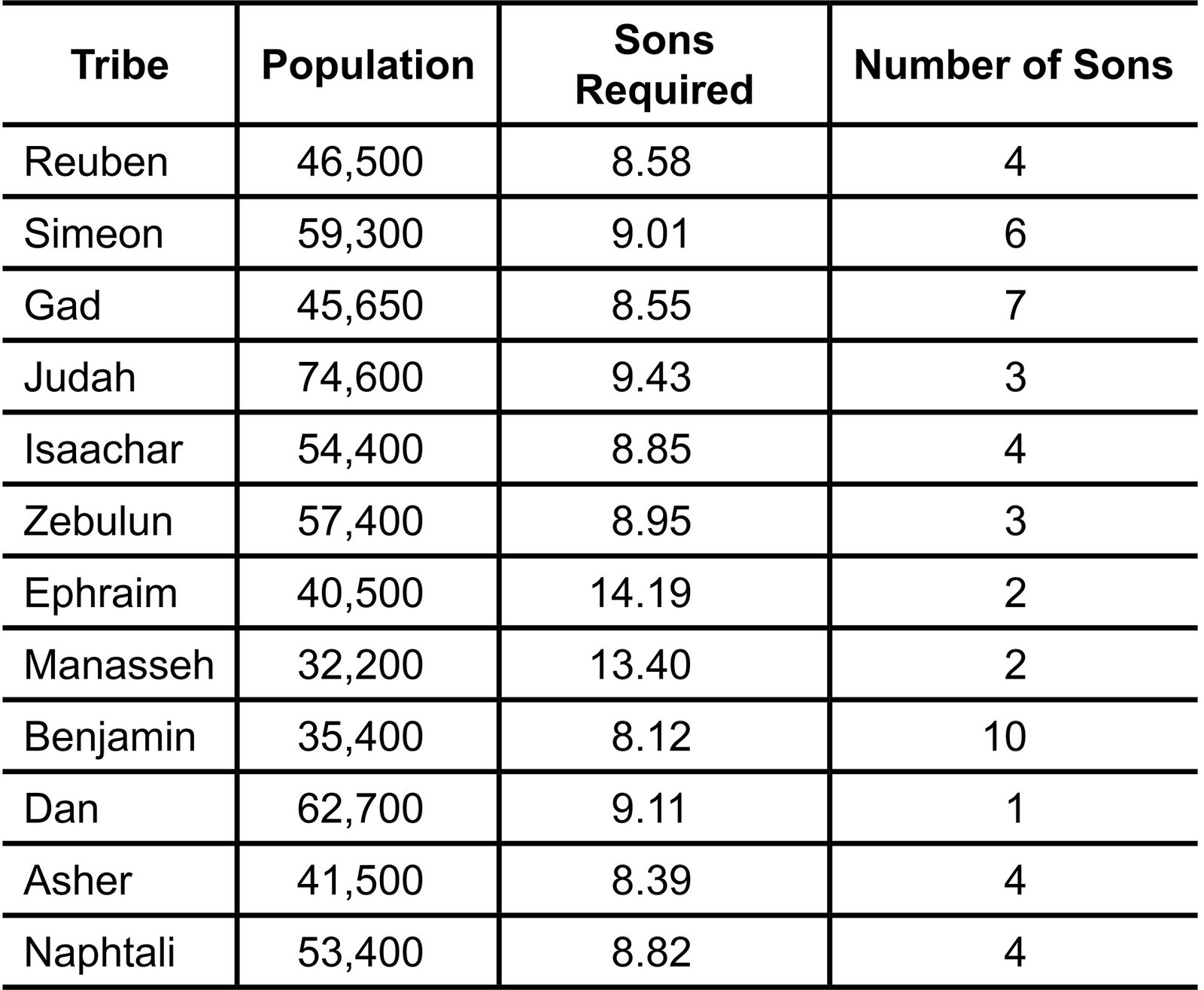
Table 1
Of all the tribes, only Benjamin had enough sons in the first generation to be on track to reach his tribe’s population during their first census. Yet by the time of that census, Benjamin had the third lowest population of the tribes with just 3,200 more men than Manasseh. The fact that Dan only had one son means that we can remove one entire generation from his line to achieve 62,700 men, so now his son would need to have 16 sons and each of his male descendants would need to reproduce sons at the same rate for two more generations (15.82 average). There can be no doubt that within the short sojourn timeframe these numbers are highly implausible, if not impossible, given the genealogical information in Scripture and the times and environment when they needed to occur.
Advocates of the short sojourn might propose that more generations could be added since people can reproduce prior to age 40. While this is true, it does not solve the problem for the short sojourn for at least two reasons. First, when addressing Genesis 15:13–16, short sojourn supporters argue that a generation during this time in history represented approximately 40 years. If that is the case, then it is special pleading to argue that each of the 11 generations in Joshua’s line (back to Joseph) averaged fewer than 20 years. Second, the notion that some additional generations can be inserted into these calculations cannot be applied to the Levitical line since short sojourn advocates claim that the line from Levi > Kohath > Amram > Moses line does not contain any gaps. It might be argued that the lines of Gershon and Merari had more generations than Kohath, but even if that were the case, it does not solve the problem because those lines (7,500 and 6,200, respectively) had lower populations than Kohath’s line, (8,600 or 8,300).
Furthermore, Judah’s lineage has been cited as evidence that the Israelites departed Egypt in the fourth generation, since Nahshon is listed as being four generations after Judah. If Moses represented the fourth generation (Levi, Kohath, Amram, Moses) then technically Nahshon would be in the fifth generation since there are three men listed between Judah and him (Hezron, Ram, Amminadab). That is a minor issue compared to the population problem in Judah’s line. According to the census in Numbers 2, the tribe of Judah had the highest population at 74,600 men aged 20 or older—more than three times the number of Levite males who were counted from one month and older. Even more problematic, Judah only had three sons that survived long enough to have children since Er and Onan died before producing offspring. So, if Levi’s and Judah’s genealogies do not contain gaps, as the short sojourn argues, then each of Judah’s three sons and each of their male descendants for the next two generations needed to produce an average of 29.2 sons. Yet the Bible states that Shelah had five sons (1 Chronicles 4:21–22), Zerah had five sons (1 Chronicles 2:6), and Perez had two sons (1 Chronicles 2:5). This results in some startling figures where each of Shelah’s five sons and their sons had to produce 70.5 sons. The problem is exacerbated for Zerah’s five sons and their sons along with Perez’s two sons and their sons who would each need to produce an astounding 111.5 sons. And just like before, these men also needed to have a similar number of daughters, and all of them needed to survive into adulthood long enough to reproduce at the necessary rate.
Other Population Problems
Most of the previous calculations were based on five generations in 215 years. Given twice the amount of time for the long sojourn, then it is reasonable to account for ten generations, which also matches the number of generations between Ephraim (Kohath’s contemporary) and Joshua (1 Chronicles 7:23–27). Over ten generations, each family within Gershon’s clan would only need to produce 2.44 sons. Even if two generations were removed to make this task a little more difficult, then each family would need to produce just 3.05 sons. These figures are entirely consistent with the family sizes described in the various biblical genealogies covering this era.
Two final observations regarding the population should be raised. The first chapter of Numbers reveals that one year after the Exodus, the non-Levite Israelites had an adult male population of 603,550. Approximately 39 years later at the end of the wilderness wandering, the population was practically the same—601,730. If the short sojourn view is correct, then the Israelites multiplied at an extreme rate for two centuries and then suddenly stopped for 40 years, having only enough children on average to nearly maintain a steady population. This would represent a drastic change in the short sojourn model, but it amounts to only a slight change in the long sojourn model.
Similarly, it is a common assumption that roughly two million Israelites left Egypt, and this figure includes men, women, and children. The short sojourn requires each family to have an extremely high number of children, but the figure of two million assumes that families included in that census averaged fewer than two children. However, the calculations used to reach two million people in a short sojourn timespan rely upon exponential growth whereas the families in the generation prior to the exodus must have decided for some unknown reason to average fewer than two children per family. Of course, short sojourn proponents could counter by pointing out that the Bible does not state that the total population of Israelites leaving Egypt was about two million. While this is true, it still leaves the short sojourn advocate with a massive problem. If they opt for a higher population to correspond to supposed large family sizes, then they will need to revise their calculations to achieve the resultant much greater population.
Conclusion
The long sojourn enjoys the near-consensus support of modern biblical scholars for several reasons. Exodus 12:40–41 explicitly teaches that the Israelite sojourn in Egypt lasted for precisely 430 years. This is consistent with every other passage relevant to the subject. It also allows for enough time for the Israelites to reach to the size of the multitude described in Numbers.
While the short sojourn has been popular among creationists who have followed Ussher’s chronology, biblical support for such a view is found wanting. As this paper has shown, the verses often cited in support of the short sojourn do not clearly teach this view, and they make more sense when interpreted in the context of the long sojourn.
Biblical creationism is rooted in the concept of biblical authority, and properly understanding the Bible is of supreme importance for those who take such a strong stand on Scripture. Those who have adopted the short sojourn need to carefully contemplate the many strengths of the long sojourn and the weaknesses of the short sojourn. While the long sojourn has little difficulty explaining the relevant passages, the short sojourn seems incapable of explaining the population statistics in Numbers and must rely upon an unlikely textual variant of Exodus 12:40–41 that is both illogical and at odds with other clear statements in Scripture. As such, biblical creationists who favor the short sojourn should seriously consider adopting the long sojourn as the biblical view of Israel’s time in Egypt. Such a change will add 215 years to the most popular creationist chronology, but if Scripture teaches a long sojourn, then it must take precedence over Ussher and other traditional views.
References
Albright, William F. 1963. The Biblical Period from Abraham to Ezra: An Historical Survey. Revised and Expanded. New York, New York: Harper and Row.
Anstey, Martin. 1913. The Romance of Bible Chronology: An Exposition of the Meaning, and a Demonstration of the Truth, of Every Chronological Statement Contained in the Hebrew Text of the Old Testament. Vol. 1. The Treatise. London, United Kingdom: Marshall Brothers Ltd.
Archer, Gleason L. Jr. 1994. A Survey of Old Testament Introduction. Chicago, Illinois: Moody Press.
Carter, Robert, and Chris Hardy. 2015. “Modelling Biblical Human Population Growth.” Journal of Creation 29, no. 1 (April): 72–79.
Carter, Robert, and Lita Sanders. 2021. “How Long Were the Israelites in Egypt?” Creation Ministries International (September 21). https://creation.com/en/articles/how-long-were-the-israelites-in-egypt.
Clement of Alexandria. 1885. “The Stromata.” In Ante-Nicene Fathers. Edited by Alexander Roberts, and James Donaldson. Vol. 2. Fathers of the Second Century: Hermas, Tatian, Athenagoras, Theophilus, and Clement of Alexandria (Entire). Buffalo, New York: Christian Literature Company.
Clines, David J. A. ed. 1993. The Dictionary of Classical Hebrew. Sheffield, United Kingdom: Sheffield Academic Press.
Cole, R. Dennis. 2000. Numbers. Vol. 3b. The New American Commentary. Nashville, Tennessee: Broadman and Holman.
Davis, John J. 1971. Moses and the Gods of Egypt; Studies in the Book of Exodus. Grand Rapid, Michigan: Baker Books.
George, Timothy. 1994. Galatians. Vol. 30. The New American Commentary. Nashville, Tennessee: Broadman and Holman.
Griffith, Kenneth C., and Darrell K. White. 2023. “Chronological Framework of Ancient History. 4: Dating Creation and the Deluge.” Answers Research Journal 16 (September 20): 475–489. https://answersresearchjournal.org/noahs-flood/chronological-framework-ancient-history-4/.
Jones, Floyd Nolen. 1993. The Chronology of the Old Testament. Revised and updated. Green Forest, Arkansas: Master Books.
Jones, Floyd Nolen. 1999. Which Version Is the Bible? Revised and enlarged. The Woodlands, Texas: Kingsword Press.
Keil, Carl Friedrich, and Franz Delitzsch. 1996. Commentary on the Old Testament. Vol. 1. Peabody, Massachusetts: Hendrickson Publishers.
Longenecker, Richard N. 1990. Galatians. Vol. 41. Word Biblical Commentary. Dallas, Texas: Word Books.
Ludwig Koehler and Walter Baumgartner. 1994. The Hebrew and Aramaic Lexicon of the Old Testament. Leiden, The Netherlands: E. J. Brill.
Matthews, Kenneth A. 2005. Genesis 11:27–50:26. Vol. 1B. The New American Commentary. Nashville, Tennessee: Broadman and Holman.
Merrill, Eugene H. 1987. Kingdom of Priests: A History of Old Testament Israel. Grand Rapids, Michigan: Baker Books.
Morris, Henry M. 1976. The Genesis Record: A Scientific and Devotional Commentary on the Book of Beginnings. Grand Rapids, Michigan: Baker Books.
Mortenson, Terry. 2020. “The Grand Canyon, Monument to an Ancient Earth: The Deceptions Continue.” Answers Research Journal 13 (December 2): 257–325. https://answersresearchjournal.org/grand-canyon-monument-ancient-earth/.
Petrovich, Douglas. 2019. “Determining the Precise Length of the Israelite Sojourn in Egypt.” The Near East Archaeological Society Bulletin 64: 23–44.
Riggs, Jack R. 1971. “The Length of Israel’s Sojourn in Egypt.” Grace Journal 12, no. 1 (Winter): 18–35.
Sibley, Andrew. 2022. “Jesuit Accommodation in Relation to Biblical Chronology and Chinese History.” Journal of Creation 36, no. 1 (April): 53–56.
Singer, Isidore, ed. 1901. The Jewish Encyclopedia: A Descriptive Record of the History, Religion, Literature, and Customs of the Jewish People from the Earliest Times to the Present Day. Vol. 3. Bencemero—Chazanuth. New York, New York: Funk and Wagnalls.
Theophilus of Antioch. 1885. “Theophilus to Autolycus.” In Ante-Nicene Fathers. Vol. 2. The Fathers of the Second Century: Hermas, Tatian, Athenagoras, Theophilus, and Clement of Alexandria (Entire). Edited by Alexander Roberts, James Donaldson, and A. Cleveland Coxe. Buffalo, New York: Christian Literature Company.
Tov, Emanuel. 1992. Textual Criticism of the Hebrew Bible. Minneapolis, Minnesota: Fortress Press.
Ussher, James. 2003. The Annals of the World. Revised and updated by Larry and Marion Pierce. Green Forest, Arkansas: Master Books.
Wenham, Gordon J. 1981. Numbers: An Introduction and Commentary. Vol. 4. Tyndale Old Testament Commentaries. Downers Grove: Illinois: InterVarsity Press.
Wenham, Gordon J. 1987. Genesis 1–15. Vol. 1. Word Biblical Commentary. Dallas, Texas: Word Books.